History of O Porriño: granite, lordships and the town of Antonio Palacios
O Porriño is the first Galician town the Camino Portugués crosses after Tui. It lived off its roads from Roman times, off granite and, in the 20th century, off industry, and it gave the world an architect who left his works here: Antonio Palacios.
From the Gándaras to the Roman road
Settlement here is very old. The Xunta’s Enciclopedia Galega Universal mentions the Palaeolithic site of the Gándaras de Budiño, a Site of Cultural Interest since 1997, and the rock carving of Monte Castelo, listed in 1975. Bell-beaker and hillfort pottery was found on monte Faro, where the Roman road passed (EGU).
That road, joining Tui and Redondela, made the valley a privileged crossroads (EGU).
Castles, monks and lords
In Suevic and Visigothic times the seigneurial system took hold and castles were built, such as Miravel, in Cans, and Orbenlle, in Budiño, both now gone. In the late Middle Ages the Church grew in power: Alfonso VII made a donation to the monastery of San Miguel de Canales, in Cans, and several noble families built fortified houses in parishes such as Cans and Mosende (EGU).
In the 17th century the area suffered Portuguese raids led by the conde de Prado. Under the Old Regime the parishes depended on two jurisdictions: Budiño, governed by its own neighbours, and Porriño, a lordship of the conde de Salvaterra (EGU).
One hypothesis recorded by the Concello derives the name from Xan Porro, a 16th-century innkeeper in the San Sebastián quarter.
A town born beside the Camino
The Concello places the origin of the town around the chapel of San Sebastián, built by the neighbours themselves so they could hear mass without travelling (Concello do Porriño). For the name, the Concello gives four hypotheses; one, legendary but not to be ruled out, derives it from Xan Porro, an innkeeper in that area in the first half of the 16th century (Concello do Porriño).
The church of Santa María was apparently built in the mid-16th century. It was first dedicated to San Xurxo (St George), apparently in 1778 to Nosa Señora da O and from 1809 to Santa María (Concello do Porriño). In Atios, already on the Camino, the chapel of the Virxe da Guía dates from 1640 (Concello do Porriño).
From 1812 to the municipality of 1835
The Constitution of 1812 abolished the lordships and created two municipalities, O Porriño and Mosende. Ferdinand VII abolished them in 1823, and in 1835 the municipality was finally established. In the mid-19th century the railway arrived, linking the town with Vigo and the rest of Spain (EGU).
At the end of that century the town added new chapels: San Bieito, built at the end of the 19th century, and the Santo Cristo da Agonía, finished in 1899 thanks to Servando Ramilo Neves, who gave the land and paid for the works (Concello do Porriño).
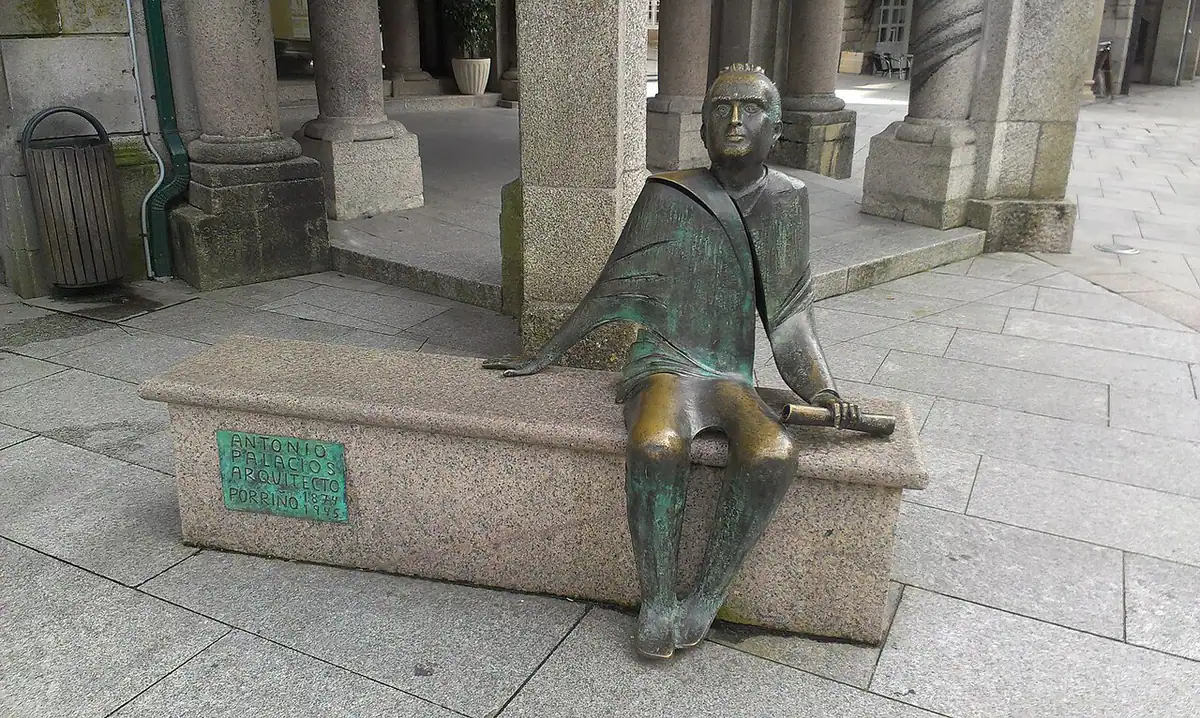
The town of Antonio Palacios
The architect Antonio Palacios was born in O Porriño on 8 January 1874 (Turismo de Galicia). In his home town he left the Fonte do Cristo (1904), the Botica Nova pharmacy (1909-1912) and the town hall (1921-1924), according to the EGU (EGU); the Concello dates the fountain to 1904 on one page and its inauguration to 1905 on another, where it dates the town hall to 1919-1924 (Concello do Porriño; Concello do Porriño).
Beside San Sebastián also stands the pavilion Palacios designed in 1919 for the Gran Vía station of the Madrid Metro; it was moved to O Porriño in 1971 and lost its iron-and-glass part (Concello do Porriño).
Granite and industry
Atios holds most of the quarries of Porriño pink granite (Concello do Porriño). In 1960 work began on the Gándaras industrial estate, part of Vigo’s development pole, and between 1970 and 1981 the population grew by 3.46 % a year; by 2001 it was double that of 1900. The Museo dos Minerais opened in 1997 (EGU).
Passing through O Porriño
Come in by the chapel of San Sebastián and the pavilion, carry on to Santa María, climb to the chapel of the Santo Cristo and leave by San Bieito towards the Virxe da Guía.
The Tui → O Porriño stage ends here and the O Porriño → Redondela stage begins. Find the town on the map.
Frequently asked questions
Where does the name O Porriño come from?
The Concello records a hypothesis, legendary but not to be ruled out: it would come from Xan Porro, an innkeeper in the San Sebastián quarter in the first half of the 16th century.
Which works by Antonio Palacios are in O Porriño?
The Fonte do Cristo (1904), the Botica Nova (1909-1912), the town hall (1921-1924) and the pavilion of the Gran Vía station of the Madrid Metro, moved here in 1971.
Since when has the municipality existed?
After a first attempt under the Constitution of 1812, the municipality was finally established in 1835.
Sources and review
- Xunta de Galicia, Enciclopedia Galega Universal: Porriño, O · accessed 27 Nov 2026
- Concello do Porriño: Camiño de Santiago · accessed 27 Nov 2026
- Concello do Porriño: Patrimonio · accessed 27 Nov 2026
- Concello do Porriño: parroquia de Porriño (Santa María) · accessed 27 Nov 2026
- Concello do Porriño: parroquia de Atios · accessed 27 Nov 2026
- Turismo de Galicia (blog): The footprint of Antonio Palacios in Galicia · accessed 27 Nov 2026
- © Rafael Ávila Coya · CC BY-SA 3.0