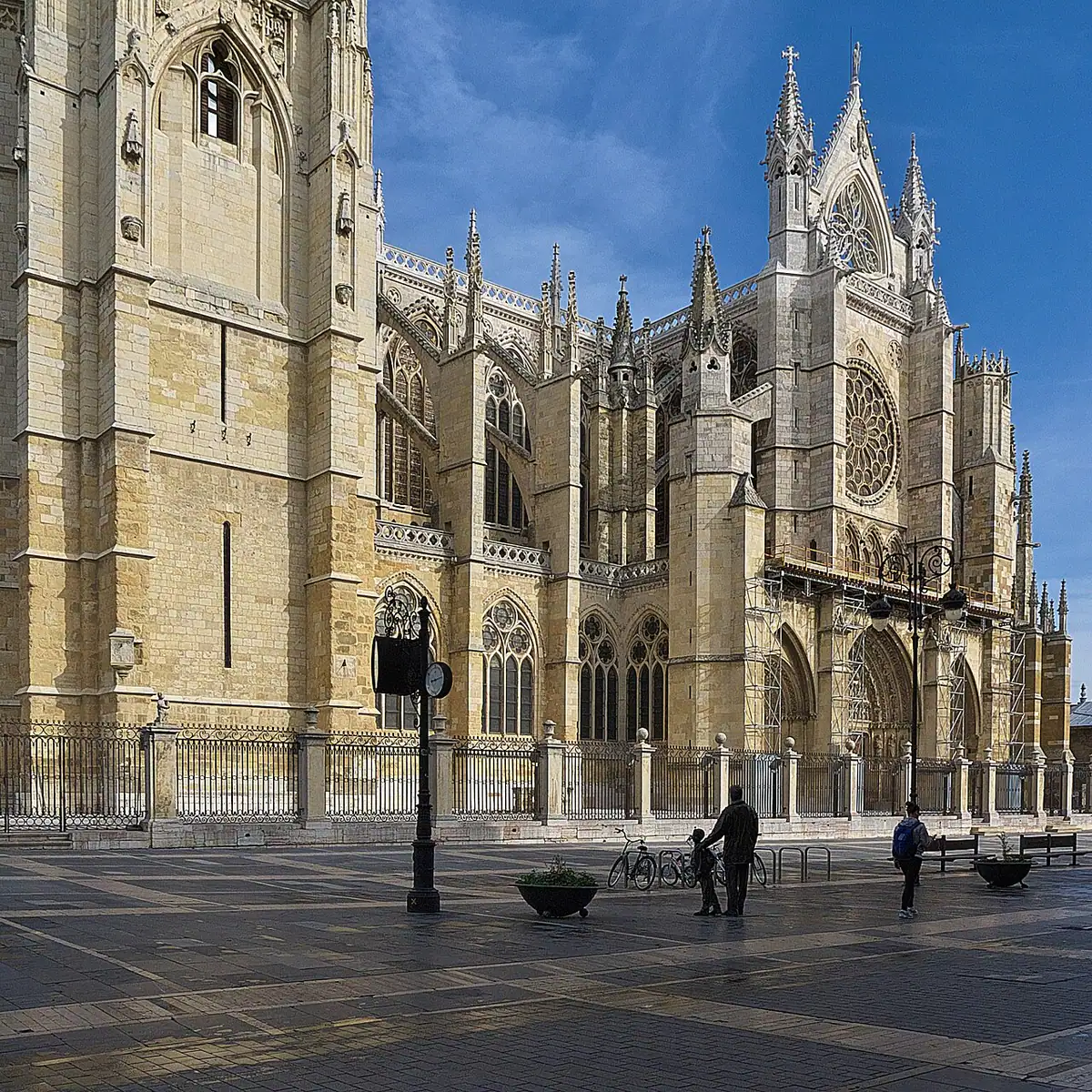
Cathedral of Santa María de Regla, León
León cathedral is, in the words of the Junta de Castilla y León, the true jewel of Spanish classical Gothic. Its Latin nickname, Pulchra Leonina, refers to the beauty of its stained glass and the balance of its heights, and it is where a walk through the medieval city centre begins.
From Roman baths to Gothic cathedral
According to the Junta de Castilla y León tourism portal, the cathedral stands on the site of 2nd-century Roman baths which, some 800 years later, King Ordoño II turned into a palace. The Junta's Pilgrim's Guide sums it up: built in the 13th century in the purest Gothic style, on the foundations of Roman baths and Ordoño II's royal palace. The official city leaflet places its construction in the 13th and 14th centuries.
The same portal says it was meant to be the largest cathedral of its time. It never was, but it did become, it says, one of the most beautiful of Spanish Gothic.
The stained glass
The figures differ between the Junta's own publications: the city leaflet speaks of 1,800 m² of medieval glass; the Pilgrim's Guide of 125 windows with more than 1,900 m²; and the tourism portal of 737 windows covering 1,765 m², made between the 13th and 20th centuries. They agree on the essentials: the coloured light pouring through the high walls is what defines the building, which the portal calls the most luminous and colourful cathedral in the region.
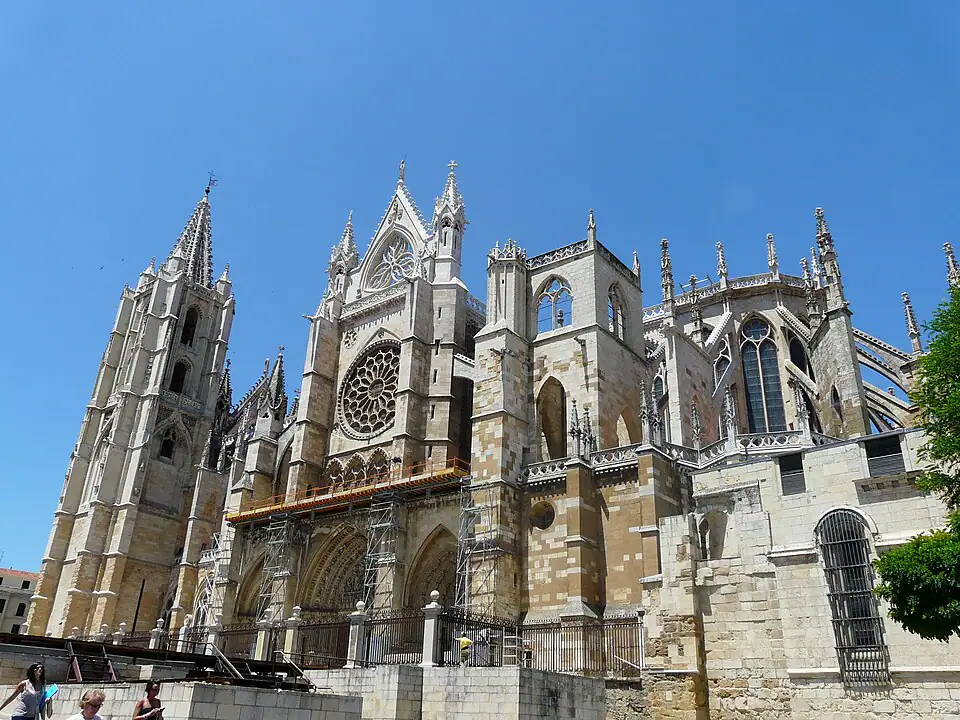
Outside, look up at the great rose window of the main façade, which the official leaflet calls extraordinary.
No less than 1,800 square metres of medieval stained glass let the light in between its high walls.
What to see
The main façade opens a central portico framed by two slender spire-capped towers. Inside, the choir keeps 76 seats carved in walnut in the 15th century, and the portal counts it among the oldest in the country. Among its images, the Virgen Blanca draws a constant flow of visitors.
A ticket to the cathedral museum also lets you see the 16th-century cloister.

Opening hours and tickets
The Junta portal only lists weekday hours, Monday to Friday: 1 October to 30 April, 9:30–13:30 and 16:00–19:00; 1 May to 30 September, 9:30–13:30 and 16:00–20:00. No visits during services.
General admission €8; reduced and groups €7; combined ticket with the museum €12 (as of November 2026). Hours and prices change: check catedraldeleon.org before you go.
A thousand years of cathedrals on one site
The cathedral's official website (catedraldeleon.org) traces the history of the site. In the mid-2nd century the Legio VII built baths and public buildings when it camped between the Torío and Bernesga rivers. In 916, after his victory at San Esteban de Gormaz, King Ordoño II gave up his royal palace for the first cathedral, under Bishop Fruminio II; he died in Zamora in 924 and his remains lie in the church, whose 13th-century epitaph thanks him for ceding his royal seat as an episcopal see.
At the end of the first millennium Almanzor laid waste to the city and its churches; even so, in 999 Alfonso V was crowned in the cathedral. Around 1067, with the church in "utmost poverty", Bishop Pelayo II and Princess Urraca promoted a new building: the Romanesque cathedral was consecrated on 10 November 1073. Bishop Manrique de Lara promoted the first Gothic works in the late 12th century, and around 1253 Bishop Martín Fernández, with Alfonso X the Wise, opened the great Gothic phase we see today.
Two modern dates close the story. On 28 August 1844 General Narváez's government declared it Spain's first Monumento Nacional. And between 1884 and 1888 the architect Demetrio de los Ríos excavated the subsoil to renew the floor and lay foundations for the pillars: he found remains of the second cathedral and drew its plan.
The stained glass, window by window
The cathedral's own website speaks of about 737 windows and about 1,765 m², though other pages round it to 1,800 m²; it calls this the largest set of Gothic stained glass in Spain. High up are 31 clerestory windows about 12 metres tall; in the triforium, 37 windows about 3.5 metres tall. Three rose windows about 8 metres across crown the west, north and south façades.
The west rose, from the late 13th century, shows the Virgin and Child ringed by 12 angel musicians; of its roughly 30 m², about 23 are original glass. The south rose, the Coronation of the Virgin, was almost entirely remade in the 19th century using the north rose as its model. The great 19th-century restoration began in 1859, when the surviving glass was taken down and stored in one of the towers; modern conservation techniques have been used since 2009. Look for the Hunting window, dated between 1264 and 1279 and restored in 2013.
The cloister and the organ
According to catedraldeleon.org, the cloister is square, 30 metres a side with eight bays, and its galleries were finished in the first third of the 14th century. You enter through the north portal, where the Virgen del Dado presides over the trumeau. Its walls keep Nicolás Francés's cycle of paintings (1459–1461) on the Redemption, and in 1540 Juan de Badajoz the Younger rebuilt roofs and vaults with medallions of the Virgin's genealogy; the wooden doors were carved in 1538.
If you catch a concert, you will hear the Klais organ, with five manuals and 63 stops, inaugurated in 2013 after almost three decades of the organ festival founded in 1984 to pay for it. Afterwards, walk on to the Basilica of San Isidoro and the San Isidoro Museum, or down to San Marcelo.
Getting there from the French Way
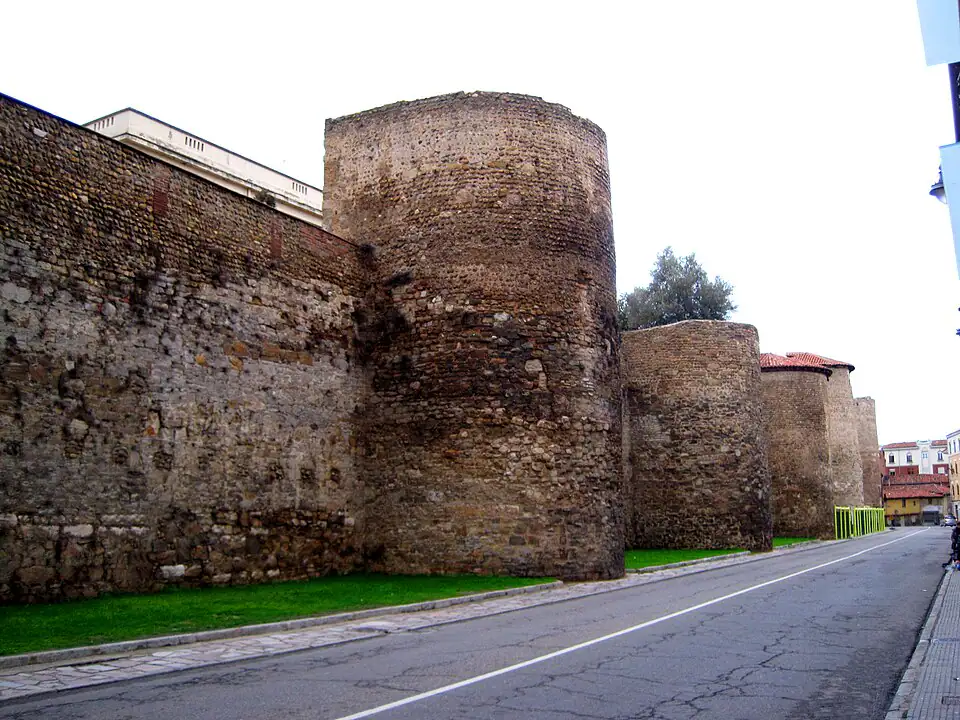
The cathedral presides over Plaza de Regla, right on the French Way through León. A few minutes' walk away are the Basilica of San Isidoro, Casa Botines and the city walls. It is a natural stop at the end of the Mansilla de las Mulas → León stage or before the León → San Martín del Camino stage. Find it on the map.
What to see nearby
-
ChurchProtected heritage (BIC)
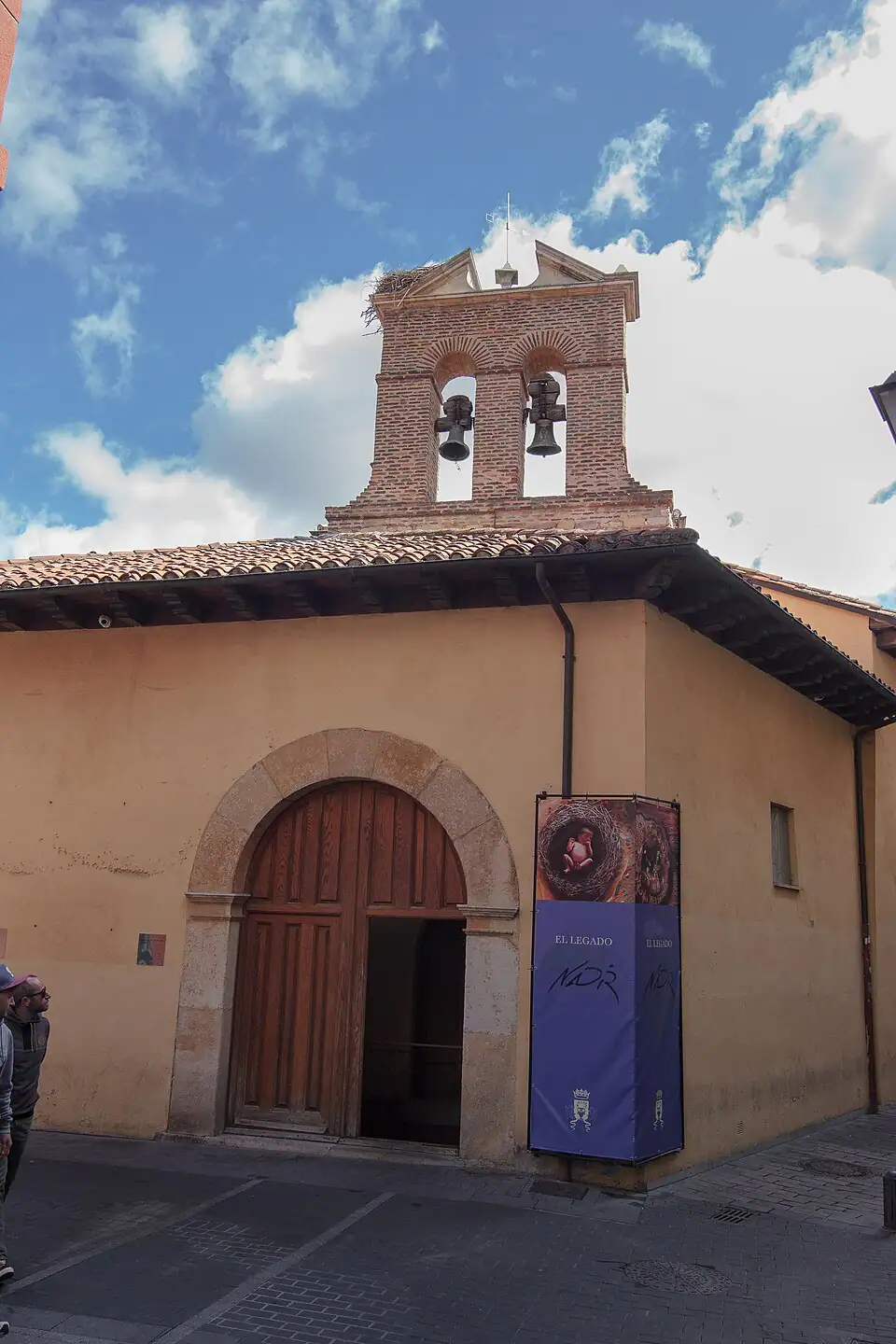
Iglesia de San Salvador de Palat del Rey
-
HeritageProtected heritage (BIC)
Basílica de San Isidoro de León



Frequently asked questions
How much stained glass does León cathedral have?
737 windows covering 1,765 m², according to the Junta tourism portal; other Junta publications give 1,800 m² or more than 1,900 m² in 125 windows.
What period is it from?
It is Gothic; the Junta places its construction in the 13th and 14th centuries.
What does Pulchra Leonina mean?
It is the cathedral's Latin nickname, owed to the beauty of its stained glass and the balance of its heights.
How much is a ticket?
€8 general and €12 combined with the museum, according to the Junta portal as of November 2026.
Sources and review
- Catedral de León (web oficial): Historia · accessed 27 Nov 2026
- Catedral de León (web oficial): Vidrieras · accessed 27 Nov 2026
- Catedral de León (web oficial): Claustro · accessed 27 Nov 2026
- Catedral de León (web oficial): portada (órgano Klais) · accessed 27 Nov 2026
- Junta de Castilla y León, Oficina de Turismo: folleto «León» (2024) · accessed 26 Nov 2026
- Junta de Castilla y León: Guía del Peregrino del Camino Francés (etapa de León) · accessed 26 Nov 2026
- Junta de Castilla y León, Turismo: Catedral de León · accessed 26 Nov 2026
- © Jl FilpoC · CC BY-SA 4.0
- © Random username 083794703875938 · CC0
- © Nacho Traseira · CC BY-SA 4.0