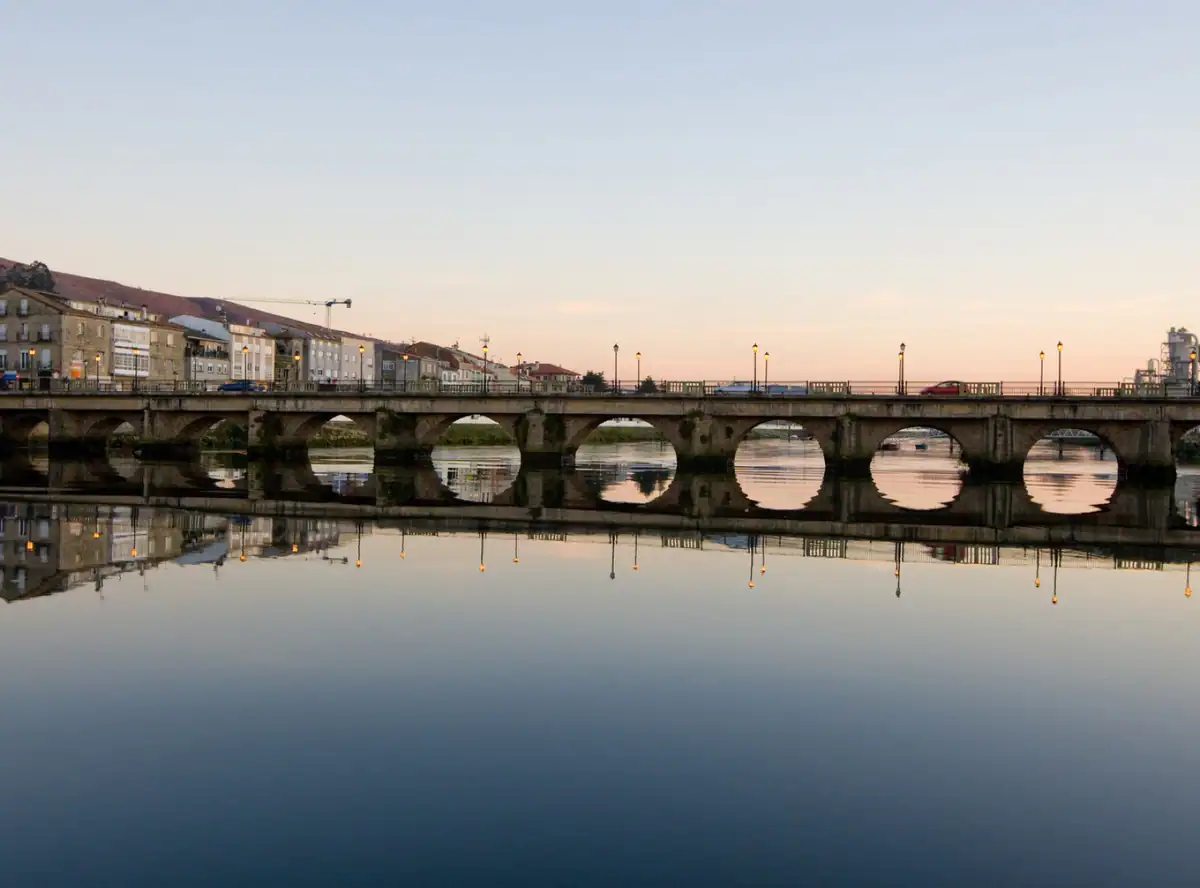
Ponte Cesures (Ponte Cesures)
Anyone entering Padrón from the south crosses the Ulla on a bridge with Roman foundations. The river is the border between the provinces of Pontevedra and A Coruña, and the bridge links two neighbouring towns: Pontecesures on the south bank and A Ponte (Padrón) on the north. It is on the Portuguese Way.
History
According to the Padrón town council, it was built between 25 BC and the 1st century AD, under Emperor Octavian Augustus, and was a route of the utmost importance. Its most important remodelling was by Master Mateo, author of the Pórtico da Gloria, in 1161.
Turismo Rías Baixas, of the Pontevedra provincial council, presents it as a 1st-century Roman bridge that gave the area its name for almost ten centuries; it notes that some historians trace its origins to Augustus, that it was remodelled several times, most notably by Master Mateo in the 12th century, and that its present appearance results from the works of 1911.
What it looks like
The Padrón town council counts thirteen spans, some with pointed vaults and others round-arched, and notes that the majesty of the Roman work can still be seen despite the alterations. Turismo Rías Baixas speaks of ten arches, and adds that the banks are full of marshland and riverside vegetation.
For the Padrón town council, the bridge linking Pontecesures and Padrón is a «symbol of union».
One bridge, two municipalities
The Ulla is the natural border between the provinces of Pontevedra and A Coruña: the south bank is Pontecesures and the north bank A Ponte (Padrón). That is why the Padrón council sees the bridge as a symbol of union between the two towns.
On the Padrón bank, the municipal guide places the town’s old outer port on the Ulla at A Ponte, a commercial quay until the late 19th century; today there is a riverside walk and a recreation area where the Sar meets the Ulla. According to the Padrón town council, A Ponte is one of the hamlets of the parish of Santa María de Iria Flavia.
Visiting
It is a public bridge: you can walk across at any time. To see it whole, go down to the bank of the Ulla, as in the photo.
Getting there from the Portuguese Way
The Portuguese Way crosses it on the Caldas de Reis → Padrón stage: it is the way into the province of A Coruña. It lies about 1.6 km in a straight line from the Church of Santiago in the centre of Padrón. See it on the map.
What to see nearby
-
-
-
Garden / parkProtected heritage (BIC)
Xardín botánico de Padrón


Frequently asked questions
Is the Cesures bridge Roman?
Its foundations are Roman, according to the Padrón council; Master Mateo remodelled it in the 12th century and its present look comes from the 1911 works.
Does it belong to Padrón or Pontecesures?
Both: the Ulla separates the provinces, with Pontecesures on the south bank and A Ponte (Padrón) on the north; the bridge links them.
Does the Portuguese Way cross it?
Yes, on the stage from Caldas de Reis to Padrón.
How many arches does it have?
The Padrón council counts thirteen spans; Turismo Rías Baixas speaks of ten arches.
Sources and review
- Concello de Padrón (Padrón Turismo): Ponte Romana · accessed 19 Nov 2026
- Turismo de Galicia (Xunta): Ponte Cesures · accessed 20 Nov 2026
- Turismo Rías Baixas (Deputación de Pontevedra): Puente romano de Pontecesures · accessed 19 Nov 2026
- Concello de Padrón: Datos básicos (parroquias e lugares) · accessed 19 Nov 2026
- OpenStreetMap: extremo norte del puente (A Ponte, Iria Flavia, Padrón) · accessed 19 Nov 2026
- Ayuntamiento de Padrón: Guía turística (PDF) · accessed 19 Nov 2026
- © Xacobea · © Xacobea