
Church of Santa María del Castillo
At the highest point of Frómista, where the castle that gives it its name once stood, rises Santa María del Castillo. Late Gothic, it is no longer used for worship: since 2008 it has housed «Vestigia, Leyenda del Camino», a multimedia show on the stories of the town and the Camino.
The castle church
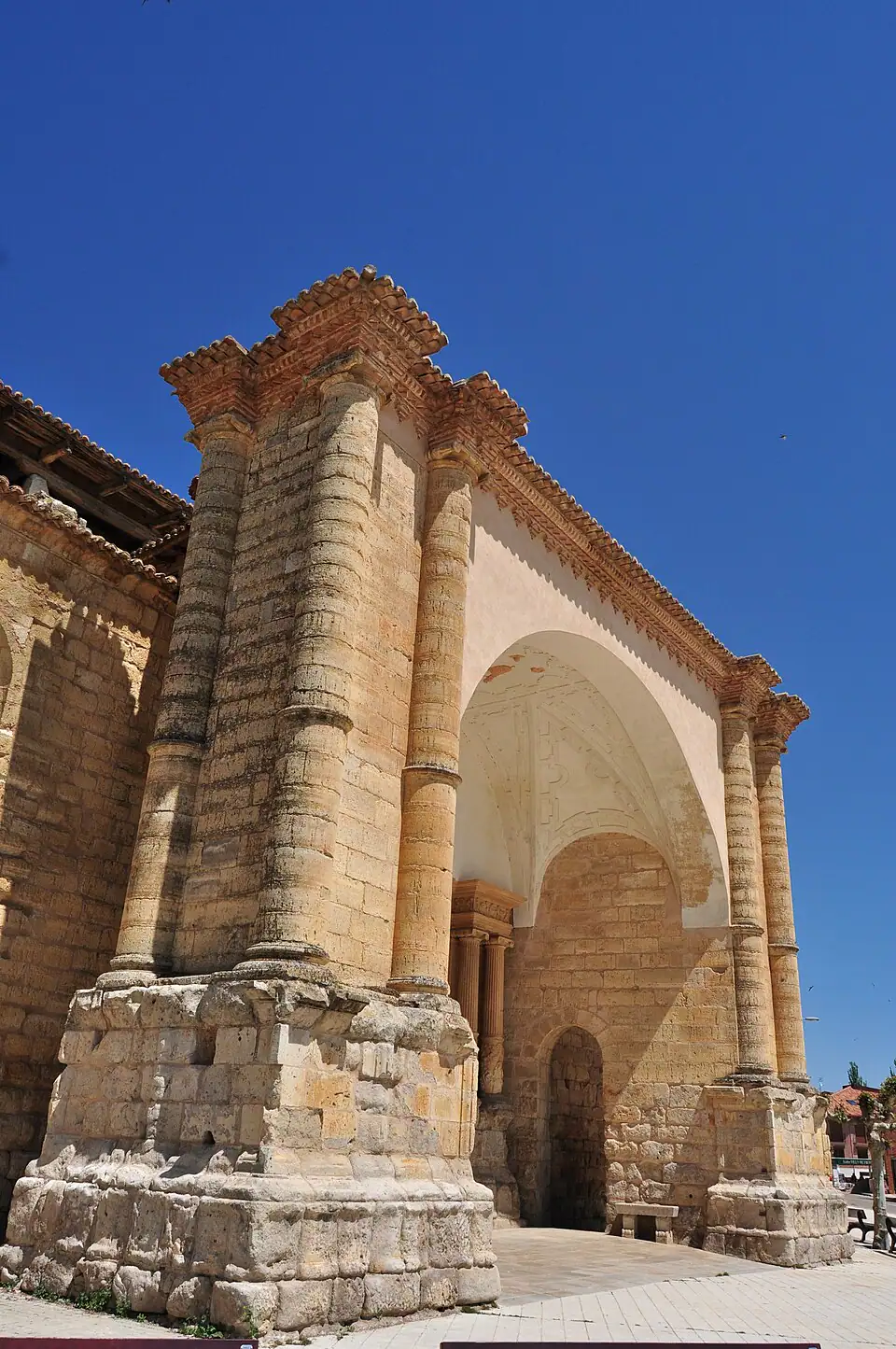
Santa María del Castillo occupies the highest part of town, where the old castle stood and from which it takes its name (Turismo Castilla y León). It is late Gothic, with three naves divided by piers under star vaults with curved ribs (town council). The Junta dates it between the 15th and 18th centuries, and the Diputación de Palencia describes it dominating the town from a promontory.
It has been a Bien de Interés Cultural since 26 January 1944 (Turismo Castilla y León; Wikidata, P1435).
An altarpiece that went to Brussels
Its fame came from the high altarpiece: 29 Hispano-Flemish panels painted under Gothic canopies (town council), 15th-century according to the Junta and from the time of the Catholic Monarchs according to the town’s history. Part of it was stolen in 1980; it was recovered in Brussels in July 1981, and the panels are now shown in the museum of the church of San Pedro.
Its high altarpiece of 29 Hispano-Flemish panels was stolen in 1980 and recovered in Brussels the following year.
Vestigia, Leyenda del Camino
Since 2008 the church has housed «Vestigia, Leyenda del Camino», a multimedia exhibition that uses images and sound to tell the stories and legends of Frómista and the Camino de Santiago (town council; Turismo Castilla y León). Contact phones: 689 031 605 and 672 146 994.
Getting there from the Camino Francés
Santa María del Castillo is in the plaza del Castillo, in the upper part of town. The Camino Francés reaches Frómista beside the locks of the Canal de Castilla: the Castrojeriz → Frómista stage ends here and the Frómista → Carrión de los Condes stage leaves westwards. Find it on the map.
What to see nearby
-
ChurchProtected heritage (BIC)
Iglesia de Nuestra Señora de la Asunción


Frequently asked questions
Why is it called «del Castillo»?
Because it stands where Frómista’s old castle was, at the highest point of the town.
Where is its altarpiece?
Its 29 Hispano-Flemish panels are displayed in the museum of the church of San Pedro.
What is Vestigia?
A multimedia show on the legends of Frómista and the Camino, in the church since 2008.
Sources and review
- Turismo Castilla y León (Junta): Iglesia de Santa María del Castillo · accessed 26 Nov 2026
- Ayuntamiento de Frómista: Arquitectura y Arte · accessed 26 Nov 2026
- Ayuntamiento de Frómista: Historia · accessed 26 Nov 2026
- Turismo Castilla y León (Junta): Museo de Arte Sacro de Frómista · accessed 26 Nov 2026
- Diputación de Palencia (Palencia Turismo): Frómista, guía del peregrino (PDF) · accessed 26 Nov 2026
- Wikidata Q43090204: Ermita de Santa María del Castillo (P1435 Bien de Interés Cultural) · accessed 26 Nov 2026
- © Luis Rogelio HM · CC BY-SA 2.0