
Church of San Saturnino (San Cernin)
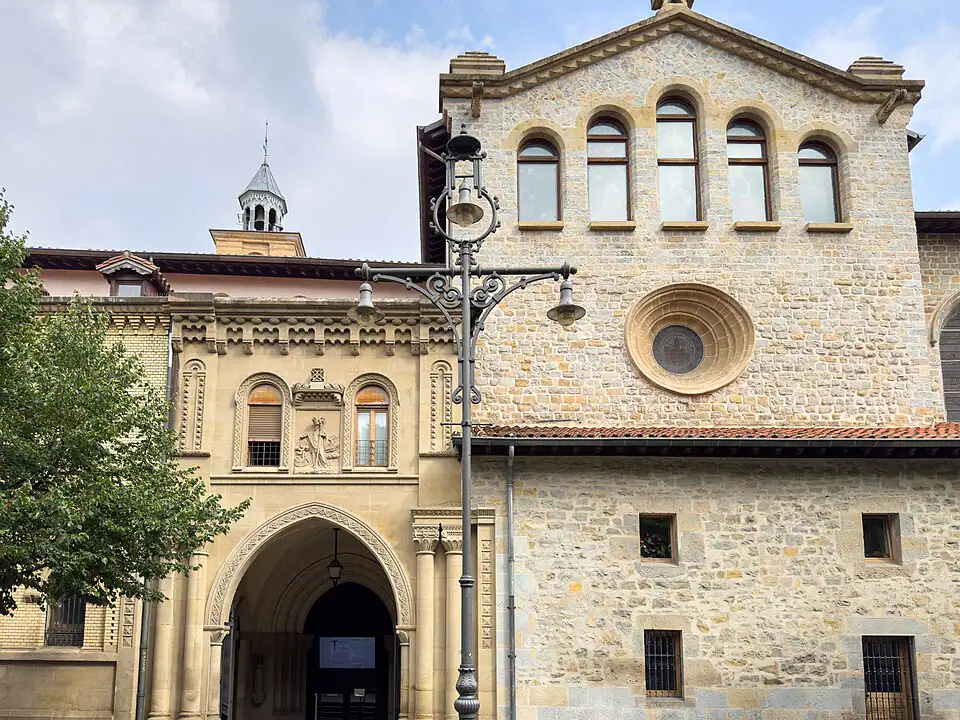
Its two tall towers, built as watchtowers, define the skyline of the old town of Iruña/Pamplona. The church of San Saturnino, San Cernin in Occitan, was the parish of the borough founded by the Franks who came along the Camino; today it keeps a Gothic Last Judgement portal and the Baroque chapel of the Virgen del Camino.
The church of the Franks’ borough
The parish explains that the borough of San Cernin was born at the end of the 11th century, when people from France settled between the Navarrería, the bishop’s city, and the open land to the west. Relations with the Navarrería were not friendly: each borough surrounded itself with its own walls, and the Franks built a church in the French manner, dedicated to San Cernin like Saint-Sernin in Toulouse.
The Romanesque church, mentioned in 1107, was attacked by the people of San Nicolás in 1222 and badly damaged in the war of the Navarrería. So between 1277 and 1297 a Gothic building was raised to serve as both church and fortress, with two towers acting as military watchtowers.
The Gothic church
The nave is 33 metres long, 16 wide not counting the chapels and 25 high; it ends in a pentagonal apse covered by a half-octagonal vault that the parish considers unique in Navarrese Gothic. Three small chapels open on each side, and the choir rises at the west end.
You enter through a 16th-century porch. The portal, from the late 13th or early 14th century, shows the Last Judgement on the tympanum, with Christ displaying his wounds between the Virgin and St John; the capitals tell the childhood of Christ on the left and the Passion and Resurrection on the right. The porch holds four tombs, among them that of the Cruzat family, and the door is flanked by copies of St James and St Saturninus whose originals are inside.
The keystone of the vault under the choir bears the year the church was finished: 1297.
The chapel of the Virgen del Camino
Tradition says that the image of the Virgen del Camino, Romanesque, polychrome and covered in silver, appeared in 1487 on a beam above the sanctuary, having come miraculously from Alfaro. As devotion grew, the Gothic cloister, which was falling down, was demolished in 1758 and a large Baroque chapel was built in its place, finished in 1774: a Greek-cross plan of 21 by 29 metres, a central dome and four smaller ones, a Baroque altarpiece and a Rococo camarín. The people of Pamplona honour her as queen and lady of Pamplona.
The gallico, the pocico and the bull runs
According to the City Council, one of its towers holds the city’s first clock, the one that marks the start of the bull runs, and since 1795 the weathervane of the south tower has been a cockerel, the “gallico de San Cernin”; there is a replica in the porch. In front of the church, on Calle Mayor, the “pocico” recalls the well where, by tradition, St Saturninus baptised the city’s first Christians. Every 29 November the co-patron is celebrated with a procession.
Admission is free and the church is accessible. The parish lists Masses Monday to Saturday at 10:00, 11:00 and 19:00.
Getting there from the Camino Francés
It stands in the middle of the old town of Iruña/Pamplona, next to the Tourist Office, end of the Zubiri – Pamplona stage (20.4 km) of the Camino Francés.
The Pamplona – Puente la Reina stage (23.9 km) starts here. See the map.
What to see nearby
-
Tower / castleProtected heritage (BIC)
Murallas y Ciudadela de Pamplona



Frequently asked questions
Are San Saturnino and San Cernin the same?
Yes: Cernin is the Occitan form of the name, brought by the borough’s Frankish settlers.
When was the church built?
The Gothic church between 1277 and 1297; the final date is on the keystone under the choir.
Do I have to pay to go in?
No, admission is free.
Sources and review
- Parroquia de San Saturnino: Historia · accessed 19 Nov 2026
- Parroquia de San Saturnino: Edificio · accessed 19 Nov 2026
- Parroquia de San Saturnino: Portada principal · accessed 19 Nov 2026
- Parroquia de San Saturnino: Capilla de la Virgen del Camino · accessed 19 Nov 2026
- Turismo de Pamplona (Ayuntamiento): Iglesia San Saturnino o San Cernin · accessed 19 Nov 2026
- Ayuntamiento de Pamplona: Guía de Pamplona 2025 (PDF) · accessed 19 Nov 2026
- © Kent Wang · CC BY-SA 4.0