Stage 3 / 33 · Camino Francés
Zubiri to Pamplona
The stage from Zubiri to Pamplona is 21.1 km, about 5 h 15 min on foot, with 170 m of total ascent and 250 m of descent.
| Distance | 21.1 km |
|---|---|
| Estimated time | 5 h 15 min |
| Elevation gain / loss | +170 m / −250 m |
| Difficulty | Moderate |
| Highest point | 557 m |
| Lowest point | 418 m |
| Villages with services | 7: Zubiri, Larrasoaña, Zuriain, Irotz, Zabaldika, Trinidad de Arre, Pamplona |
| Longest stretch without services | 5.7 km |
| Updated |
Reviewed:
We organise it for you: bed, luggage and support Plan my Camino
Travelling as a group? Rooms close together, one quote.
Today on the Camino
Finding where you are…
Next village—
To Pamplona—
You’ve arrived: log the stage
Log stageBeds nearby
Need a taxi or luggage transfer? We’ll arrange it
Where to stay in Pamplona
You pay at the property.
Where to stay in Pamplona
Antique Pamplona Tres Reyes Apartments
House / apartmentApartamento Larrabide Nórdico
House / apartmentPilgrim hostels in Pamplona(2)
No reservations: beds go first come, first served. A guaranteed bed every night? Plan your Camino
Elevation profile
Waymarked route (OpenStreetMap); official distance: Junta de Castilla y León; elevations from a digital terrain model.
Map
Zoom in to see more places to stay
What you will see on the way
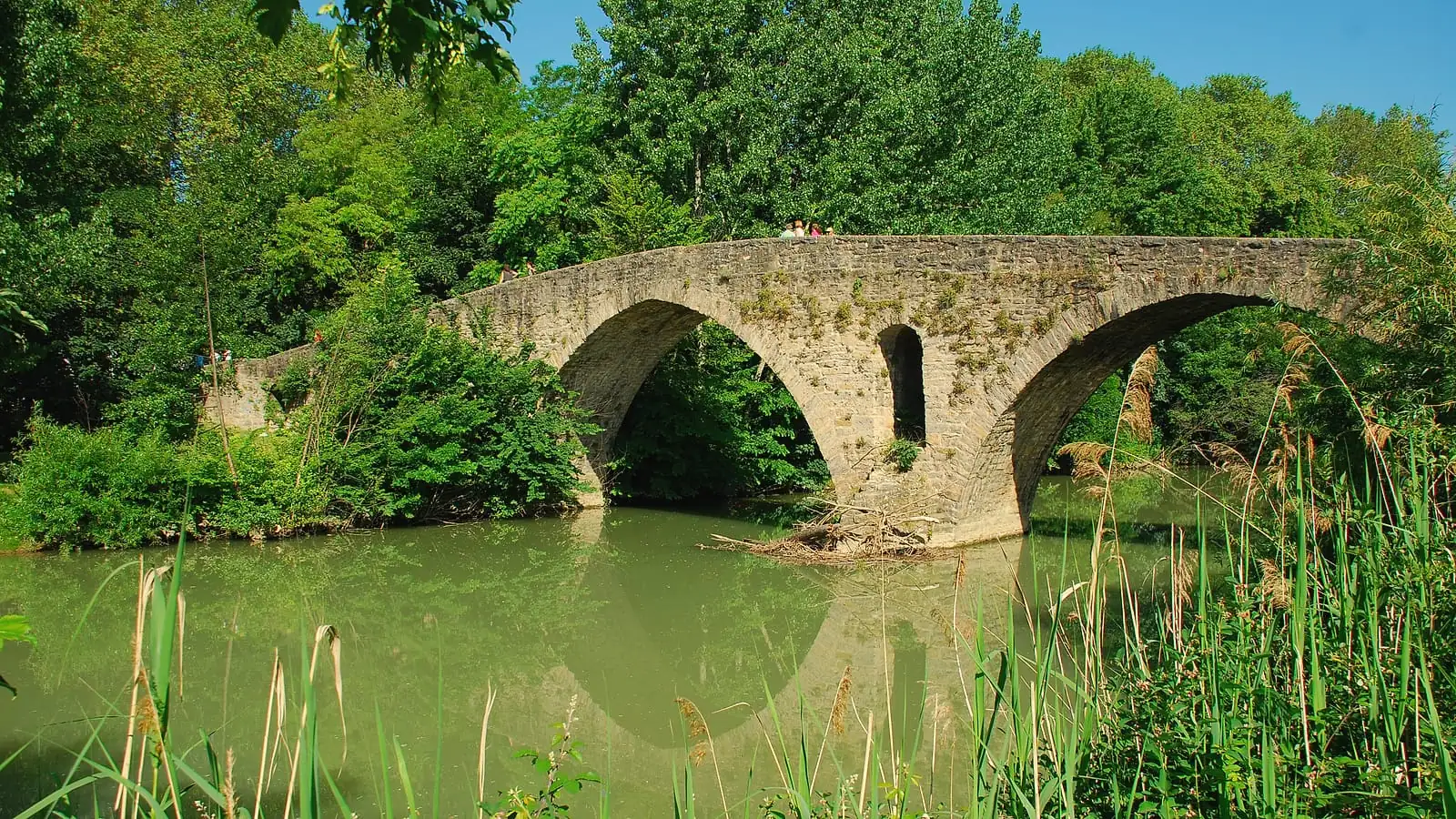
The river Arga guides the stage past Larrasoaña, a medieval town with a pilgrim hospital, and the hermitage of Zabaldika, where the nuns invite you to ring the bell. Trinidad de Arre leads into Pamplona over the Magdalena bridge and through the Portal de Francia: Gothic cathedral, city walls and the Estafeta street of the Sanfermines. It is 21.1 km and nearly flat, from 525 to 450 m above sea level. There is a bar every few kilometres: Larrasoaña (km 5.7), Zuriain, Irotz and Trinidad de Arre (km 17.6), which also has a shop and a pharmacy.
History of Pamplona
Pamplona (Iruña), capital of Navarre and the first large city on the Camino Francés, was founded by Pompey around 75 BC on a Vascon settlement. Its three medieval boroughs were merged into a single town by Charles III the Noble's Privilege of Union in 1423.
You enter over a drawbridge, walk streets that were once three rival towns and end up before the tomb of a king.
What not to miss in Pamplona
- Portal de Francia
- Cathedral of Santa María la Real: Gothic, with cloister and royal tomb
- Church of San Saturnino
Origins and the Camino
In the Middle Ages the bishop's Navarrería and the Frankish boroughs of San Cernin and San Nicolás lived side by side, often in conflict.
Anecdotes, curiosities and legends
Pilgrims enter through the Portal de Francia, built in 1553 and the best preserved of the six gates in the walls. Its drawbridge is the only one left in the city.
Tradition says that Saint Saturnin baptised Pamplona's first Christians, Saint Fermín among them, with water from a well in front of the church of San Saturnino.
Villages along the way
| Village | km | Altitude | Services |
|---|---|---|---|
| Zubiri · Places to stay | 0 | 525 m | BarShopPharmacyATMDoctorWater fountain |
| Larrasoaña | 5.7 | 500 m | BarShopWater fountain |
| Zuriain | 9.8 | 490 m | Bar |
| Irotz | 11.9 | 470 m | BarWater fountain |
| Zabaldika | 13.4 | 480 m | Water fountain |
| Trinidad de Arre | 17.6 | 430 m | BarShopPharmacyATMDoctorWater fountain |
| Pamplona · Places to stay | 21.1 | 450 m | BarShopPharmacyATMDoctorWater fountain |
© OpenStreetMap
Related guides
Your Camino organized, nothing to worry about
Free, no obligation · Reply within 24 h
Xacobeo 2027 Holy Year: dates and when to book
Do you run a business on this stage?Advertise here