History of León: from the Roman legion to the Pulchra Leonina
León owes its name to a Roman legion, was the seat of a kingdom for three centuries and keeps a Gothic cathedral famed for its stained glass. Here is the story, step by step, as the official sources tell it.
A city born from a camp
León stands on the banks of the Bernesga over a Roman military camp. According to the Junta de Castilla y León, it was founded on the camp of the Legio VI Victrix, and its name comes from the Legio VII, which camped here at the end of the 1st century AD. Civil buildings sprang up around the camp.
Excavations have uncovered the baths and other buildings of the camp, as well as an amphitheatre, one of the civil buildings that arose outside the enclosure. In the Puerta Obispo crypt, a 300-square-metre room, you can see remains of the Porta Principalis Sinistra, the camp’s eastern gate, and of the latrines of the baths. Other remains are spread across the Cascalería crypt, a Roman storehouse in the San Pedro district, El Cid Garden, with remains of the water pipes, and the Puerta Castillo Archaeology Centre.
The walls
Long stretches of the walls still stand. According to the Junta, they were destroyed several times during Muslim raids and rebuilt by Alfonso V and Alfonso IX, and were extended throughout the Middle Ages. Only one of their gates survives; its present triumphal-arch form comes from an 18th-century reconstruction.
The cathedral has 737 stained-glass windows covering 1,765 square metres, made without interruption between the 13th and 20th centuries.
Capital of a kingdom
After the barbarian and Muslim invasions, León saw the rise, from the 10th century, of the monarchy and the great noble lineages of north-west Iberia. The San Isidoro Museum places the seat of the Kingdom of León in the city from 910, under García I, until 1230, when Alfonso IX died.
Buildings from that period include San Salvador de Palat del Rey, founded as a monastery in the 10th century, and above all the San Isidoro complex.
San Isidoro and the Royal Pantheon
Around 956 King Sancho I “the Fat” founded a monastery to which his sister, the nun Elvira Ramírez, moved with her community from Palat del Rey; the Infantado of León began with her. The first church, of rammed earth and brick, built by Alfonso V, was dedicated to Saint John the Baptist. On 21 December 1063 Fernando I and Sancha, who had their palace here, brought the relics of Saint Isidore from Seville and rebuilt the church in stone in the Romanesque style. In the 12th century it was enlarged by the infanta Sancha Raimúndez, at whose request the canons regular of Saint Augustine settled here in 1148.
The Royal Pantheon was the church’s entrance porch and the place Fernando I and Sancha chose as their family burial ground: 33 kings, queens, princes and nobles were buried there between the 11th and 13th centuries. Its vaults preserve, in their original place, one of the largest and best-preserved sets of Romanesque painting, with scenes from the life of Christ and a calendar of twelve medallions showing farm work. The museum keeps the Chalice of Doña Urraca.
1188: the curia of Alfonso IX
In 1188, during the reign of Alfonso IX, a curia plena was convened in the cloister of San Isidoro. The museum notes that UNESCO recognises it as the birth of the European parliamentary system, and the Junta presents it as the first parliamentary Cortes in Europe.
The cathedral, Pulchra Leonina
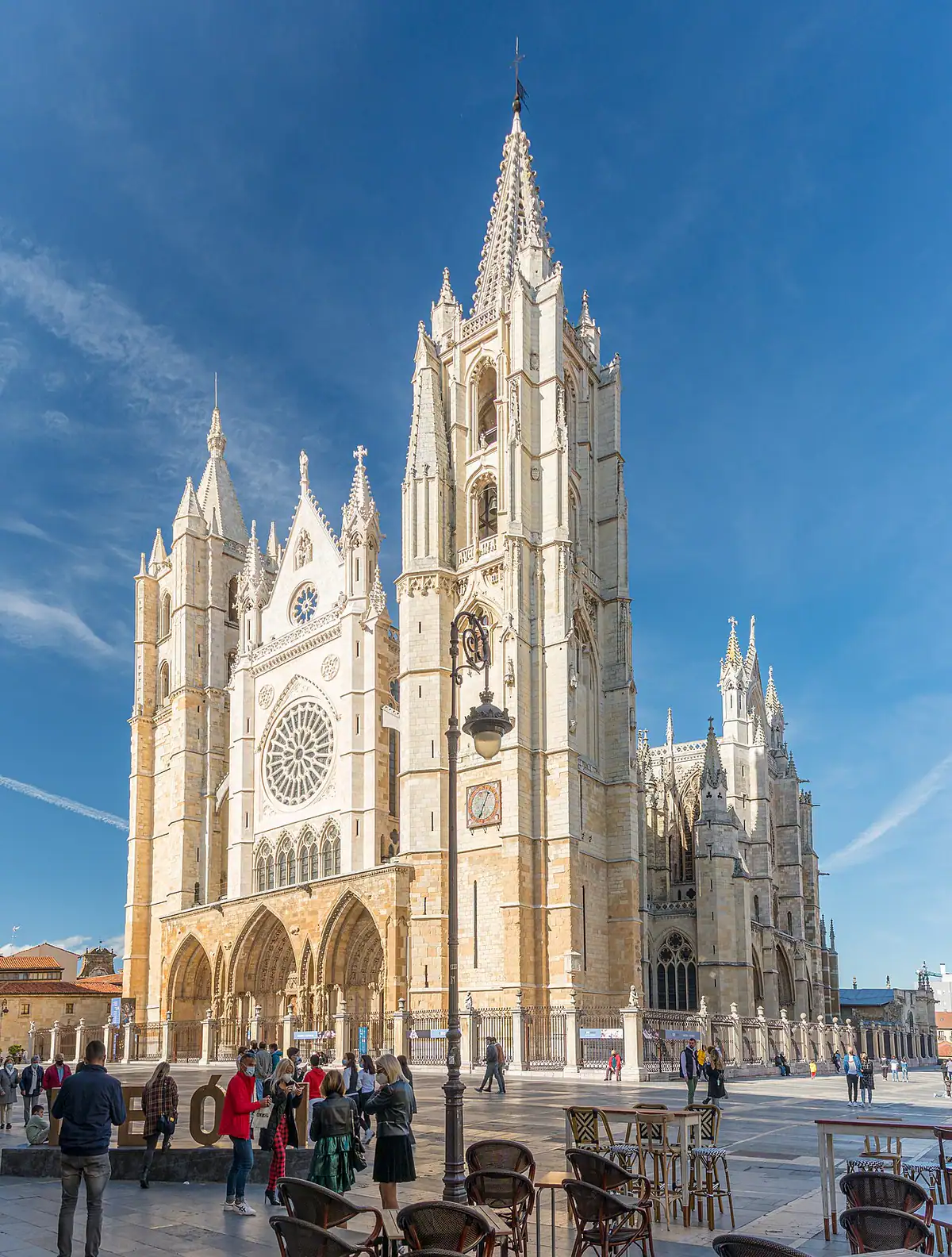
The cathedral stands on the site of 2nd-century Roman baths which, eight centuries later, King Ordoño II turned into a palace. The Junta describes it as a perfect example of French-inspired Gothic, built in the 13th and 14th centuries, with a central portico between two spired towers, a great rose window and one of the oldest choirs in the country. The White Virgin presides over the portal; the original statue is kept inside.
Its Latin nickname, Pulchra Leonina, refers to its beauty. What sets it apart is the light: 737 stained-glass windows totalling 1,765 square metres, made continuously between the 13th and 20th centuries.
San Marcos and the Renaissance city
The convent of San Marcos was the former mother house of the Order of Santiago. Its Plateresque façade went up in the 16th century, and its church, of the same period, holds choir stalls by Juan de Juni. Part of the building is now a hotel.
From the same century come the Palacio de los Guzmanes, seat of the provincial council, and the church of San Marcelo, dedicated to the city’s patron saint, with two carvings by Gregorio Fernández. The old town hall on the Plaza Mayor was built at the end of the 17th century.
Gaudí in León: Casa Botines
At the end of the 19th century Antoni Gaudí built a building in León for a textile business: Casa Botines, with façades on four streets and a tower at each corner. It was declared a National Historic Monument in 1969 and is now a museum; the original 1893 tower is kept under its roof.
León on the Camino Francés
León lies right on the Camino Francés. Crossing the Plaza del Grano, pilgrims pass Nuestra Señora del Mercado, a Romanesque church from the first half of the 12th century, much altered over time. Every year, on the Sunday after 26 April, the cloister of San Isidoro hosts Las Cabezadas, recalling an old dispute between the town council and the clergy.
Frequently asked questions
Where does the name León come from?
From the Legio VII, the Roman legion that set up its camp here at the end of the 1st century AD.
When was León the seat of the kingdom?
According to the San Isidoro Museum, from 910, under García I, until 1230, when Alfonso IX died.
What happened in León in 1188?
Alfonso IX convened a curia plena in the cloister of San Isidoro, which UNESCO recognises as the origin of the European parliamentary system.
How many stained-glass windows does the cathedral have?
737 windows covering 1,765 square metres, made between the 13th and 20th centuries.
What is the Royal Pantheon?
The old porch of San Isidoro, where 33 royals and nobles were buried between the 11th and 13th centuries, with Romanesque paintings in their original place.
Which Gaudí building is in León?
Casa Botines, from the late 19th century, a National Historic Monument since 1969 and now a museum.
Sources (9)
- Junta de Castilla y León, Turismo: folleto «León ciudad» (accessed 19 Nov 2026)
- Junta de Castilla y León, Turismo: Ruta romana en León (accessed 19 Nov 2026)
- Junta de Castilla y León, Turismo: Catedral de León (accessed 19 Nov 2026)
- Junta de Castilla y León, Turismo: León (capital de provincia) (accessed 19 Nov 2026)
- Junta de Castilla y León, Turismo: Museo Casa Botines Gaudí (accessed 19 Nov 2026)
- Turismo de León (Ayuntamiento): Centro de Interpretación del León Romano (accessed 19 Nov 2026)
- Museo de San Isidoro de León: Nuestra historia (accessed 19 Nov 2026)
- Museo de San Isidoro de León: La basílica (accessed 19 Nov 2026)
- Museo de San Isidoro de León: El Panteón Real (accessed 19 Nov 2026)
- © Fernando (CC BY-SA 4.0)