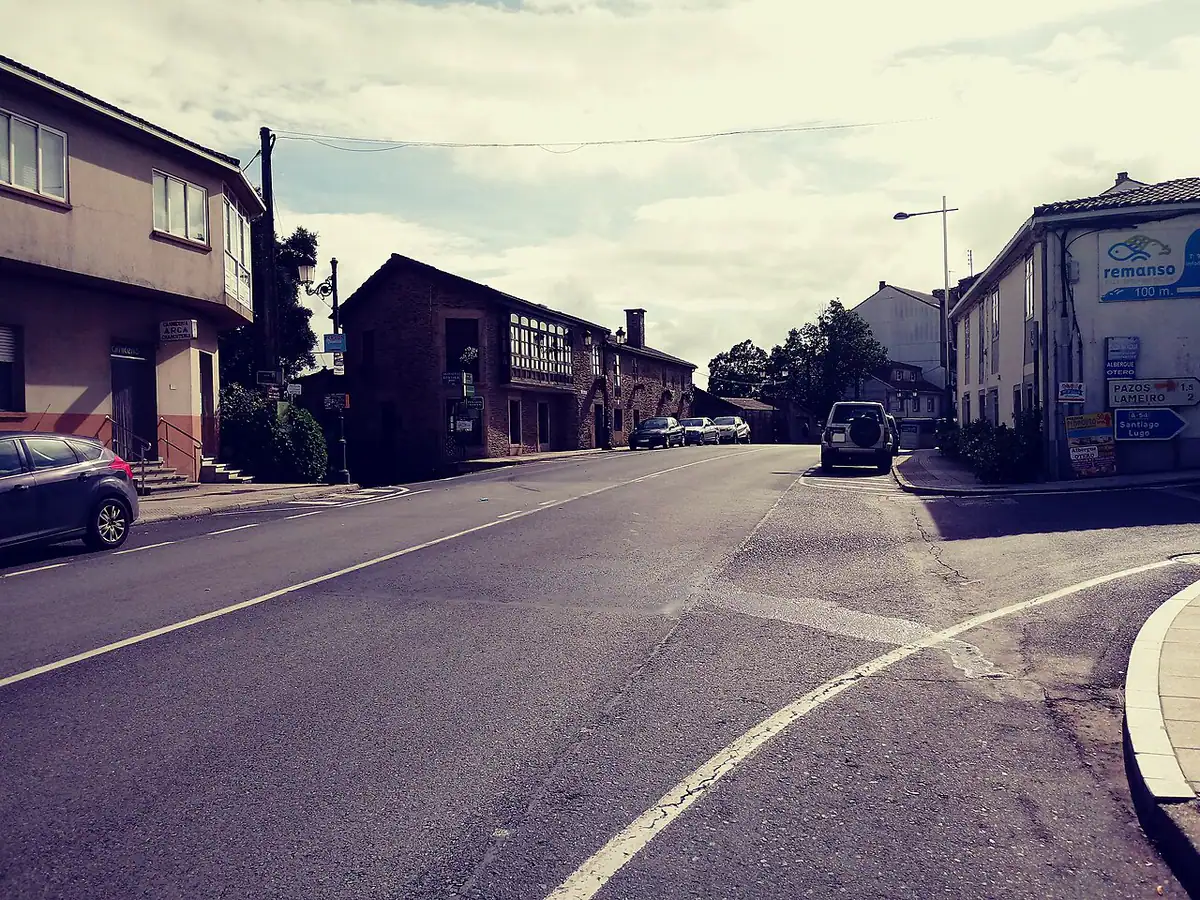
History of O Pedrouzo and O Pino
O Pedrouzo, in the parish of Arca, is the main town of O Pino and lies about 18 km from Compostela: for many pilgrims, the last night of the Camino. No other Galician municipality has so many kilometres of the Camino Francés, and beneath its oak woods lie hillforts, a Roman road and some of the most curious stories of the Arzúa district.
A municipality in the heart of Galicia
According to the council, O Pino lies almost in the centre of Galicia, in the south-south-east of the province of A Coruña. It covers 132.3 km² in thirteen parishes (Arca, Budiño, Castrofeito, Cebreiro, Cerceda, Gonzar, Lardeiros, Medín, Pastor, Pereira, O Pino, San Mamede and San Breixo de Ferreiros) and belongs to the Arzúa district. It is the first municipality you reach leaving Santiago on the N-547 towards Lugo, and several runways of Lavacolla airport lie within it.
The terrain is gentle, between 200 and 450 metres; the highest point is Monte das Minas (452 m). The Tambre marks the northern boundary, with the Mera as its main tributary.
Hillforts, gold and a Roman road
At the hillfort of San Lourenzo de Pastor, at 412 metres, an oval enclosure 110 metres long was recorded, with plain pottery and two 22-carat gold torcs weighing 350 grams, now on display in the Archaeological Museum of San Antón Castle in A Coruña. The council also mentions the hillforts of Oza (San Mamede de Ferreiros) and Tarroeira (O Pino).
Over the river Mera at Ponte Puñide stands the Roman bridge. A bronze modius was found there, now in the National Archaeological Museum, dated by its inscription to the years 360/370. According to the council, Roman road XIX ran through this area.
O Pino is the Galician municipality with the most kilometres of the Camino Francés: eighteen.
Eighteen kilometres of Camino
In O Pino the Camino Francés covers eighteen kilometres and five parishes: San Breixo de Ferreiros, San Miguel de Cerceda, Santa Eulalia de Arca, San Miguel de Pereira and Santa María de Castrofeito. It enters by the hamlets of Calzada and Calle and runs to the edge of Lavacolla airport, already in Santiago. The council highlights the chapel of Santa Irene with its fountain and oak grove, the hamlets of Calzada and A Rúa with their fountain and the Pazo de Dúas Casas, and the hostels of Santa Irene and O Pedrouzo.
Another route crosses the municipality: the Camino del Norte in its A Mota variant, the old road from the monastery of Sobrado dos Monxes to Compostela. It follows Roman road XIX through Medín, Gonzar and Castrofeito and joins the Camino Francés at Lavacolla.
The Camino de Santiago through O Pino is listed as a historic territory among the Xunta’s Sites of Cultural Interest. Decree 227/2011 defined the main route of the Camino Francés up to the boundary of O Pino, except for the section between Amenal and the airport, defined by Decree 144/2012.
The Espiritada of Gonzar
The council devotes a page to Josefa de la Torre, born on 11 November 1773 in Gastrar. Married in Gonzar and widowed at 30, in November 1806 she fell gravely ill after going out from the heat of the kitchen into the rain, and was left paralysed and almost blind. Chroniclers say she went about forty years without eating, taking communion once a month.
The Church tried to verify it: three Benedictines and a priest watched her for 17 days without finding anything. In 1838 José Varela de Montes, professor of physiology in Santiago, published the “History of the sick woman of Gonzar”. Josefa died in 1848; so many people came to her burial that they broke the stone font of the church of Santa María de Gonzar. According to the council, she rests beneath the altar of Our Lady of Carmel in that church.
Luís Seoane and Arca
The painter and writer Luís Seoane was born in Buenos Aires on 1 June 1910, but his mother, María López Mosquera, was from Arca. In 1916 the family returned to Galicia and, when she inherited a plot in Arca, built a house that, by all indications, is the building now opposite the Arca hostel. Luís and his brother Rafael went to secondary school in Santiago, sometimes on foot, some 18 kilometres.
With the outbreak of the Civil War Seoane went into exile in Buenos Aires. The council recalls that in his article “Confesión” (1965) he described himself as coming from A Coruña, Santiago and the village of Arca, where his childhood and youth were buried.
Churches, manor houses and the piñeiro rooster
The council highlights the church of San Xulián de Lardeiros, known as the “Cathedral of the Mountain” for its size, and that of Santa María de Gonzar. Among the manor houses it mentions the Pazo of the Marquis of Montesacro, or of Bermás, with the largest cedar in Galicia; all are private and cannot be visited without the owners’ permission.
The best-loved emblem is the galo piñeiro, the chicken breed the council considers native to O Pino. Its festival, the Festa do Galo Piñeiro e Mostra Cabalar, is held in O Pedrouzo on the first weekend of August.
O Pedrouzo on the Camino
O Pedrouzo ends the stage from Arzúa (19.3 km) and starts the last stage to Santiago (19.4 km) of the Camino Francés. See the map.
Frequently asked questions
Which municipality is O Pedrouzo in?
O Pino, of which it is the main town; it lies in the parish of Arca, in the Arzúa district (A Coruña).
How many kilometres of Camino Francés does O Pino have?
Eighteen: according to the council, it is the Galician municipality with the most kilometres of the Camino Francés.
Are there Roman remains?
Yes: the bridge of Ponte Puñide over the Mera, where a bronze modius from 360/370 was found, and the line of Roman road XIX.
Who was the Espiritada of Gonzar?
Josefa de la Torre (1773–1848), said to have lived some forty years without eating; the physician Varela de Montes wrote about her in 1838.
What links Luís Seoane to O Pedrouzo?
His mother was from Arca, O Pedrouzo’s parish, and he spent part of his childhood and youth there.
Sources (6)
- Concello de O Pino: Situación, xeografía, economía (accessed 19 Nov 2026)
- Concello de O Pino (turismo): Camiño de Santiago (accessed 19 Nov 2026)
- Concello de O Pino (turismo): Que ver (accessed 19 Nov 2026)
- Concello de O Pino: Persoeiros históricos — Espiritada de Gonzar (accessed 19 Nov 2026)
- Concello de O Pino: Persoeiros históricos — Luís Seoane (accessed 19 Nov 2026)
- Xunta de Galicia: Bens de Interese Cultural de Galicia (Consellería de Cultura) (accessed 19 Nov 2026)
- © Castelao (CC BY-SA 4.0)