History of Santiago de Compostela: from the apostle’s tomb to a World Heritage city
Santiago de Compostela began not as a city but as a shrine. It all started with a tomb in a forest, and church after church rose over it, up to the cathedral that ends every Camino de Santiago today.
A tomb in the forest of Libredón
According to tradition, the tomb of the apostle Saint James came to light in the early 9th century in the forest of Libredón. The official sources differ on the details: Turismo de Galicia dates to 25 July 813 the confirmation of the find by Bishop Teodomiro of Iria, at San Fiz de Solovio, which would become Compostela; the city’s tourism leaflet credits the hermit Paio with the discovery in 814.
King Alfonso II ordered a small church built next to the Roman temple that had been found. As the news spread across Europe, pilgrims began to arrive. Alfonso III raised a larger church, consecrated in 899, and around it the settlement that would become the city took shape.
Almanzor and the rebuilding
In 997 Almanzor attacked the city, destroyed the church and carried off its bells and doors as plunder. Bishop Pedro de Mezonzo, who had fled and saved the relics, rebuilt the church. The fame of the tomb kept growing, and the new church again proved too small for so many pilgrims.
The cathedral was the founding stone of Santiago: the city grew up around the tomb.
The Romanesque cathedral and Master Mateo
In 1075 work began on the basilica that survives today: Romanesque, on a Latin-cross plan. Construction started at the Chapel of the Saviour, in the apse. The main nave is 94 metres long and its barrel vault rises to 24 metres. Beside the cathedral the Pazo de Xelmírez was built in the 12th century; it is now the seat of the Archdiocese. The Praterías façade is the oldest of those that survive.
Between 1168 and 1188 Master Mateo solved the slope of the site, a drop of about 12 metres from the apse to the west end, with a crypt, and closed the west front with the Pórtico da Gloria, which tells the History of Salvation in more than 200 figures. In 1211 the cathedral was consecrated.
From the Renaissance to a Baroque city
The Royal Pantheon was created in 1238; Fernando II and Alfonso IX are among those buried there. In the Renaissance, Bishop Alonso III de Fonseca ordered the present cloister. The Catholic Monarchs had the Hospital Real built to shelter pilgrims and the sick, now a Parador, and in 1512 Joanna and Philip the Handsome spent a night in a house on Rúa das Casas Reais.
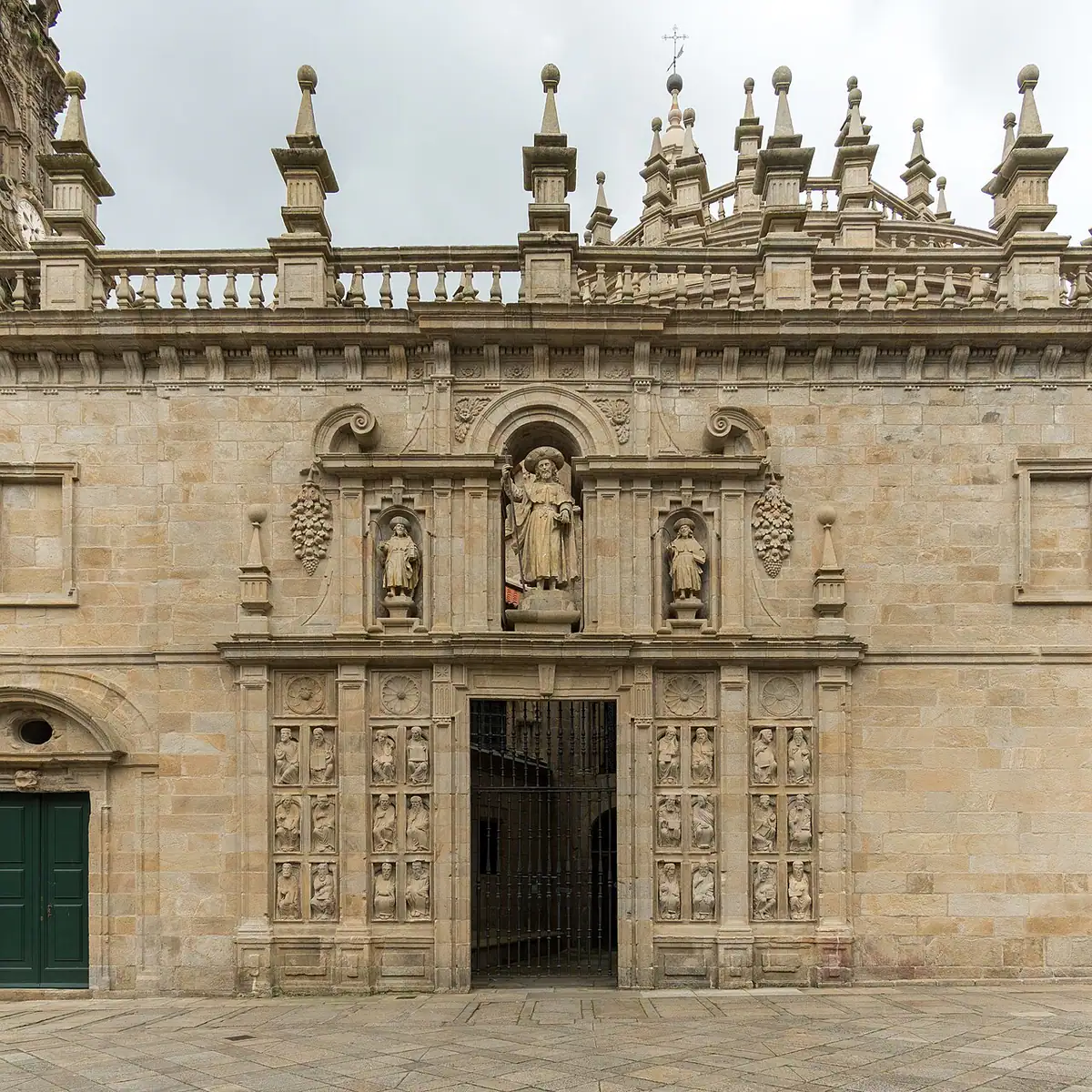
In the 17th and 18th centuries the cathedral, and the city with it, became a Baroque jewel. In 1680 Domingo de Andrade raised the Clock Tower to 73 metres. From 1738 Fernando de Casas y Novoa drove the Obradoiro façade; its towers reached 74 metres in 1747, and he died before seeing it finished in 1750. Square and façade take their name from the stonemasons’ workshops, the obradoiros. Facing Praza da Quintana, on the east façade, is the Holy Door, opened only in Holy Years.
The pilgrims’ goal
The cathedral is the goal of every Camino de Santiago, from the Camino Francés to all the others. Since the late 20th century pilgrimage has grown stronger: the 1993 Holy Year brought more than 100,000 pilgrims on foot, by bicycle or on horseback, and 2004 brought 180,000. Today the cathedral receives more than 300,000 pilgrims and around three million visitors a year.
The old town was declared a protected ensemble on 9 March 1940, extended on 30 April 1976. UNESCO inscribed it as a World Heritage Site on 4 December 1985, for its Romanesque cathedral, its influence on the art of Galicia and northern Iberia and its link with pilgrimage. The Camino de Santiago followed in 1993.
Frequently asked questions
When was the apostle’s tomb discovered?
According to tradition, in the early 9th century. Turismo de Galicia gives 813 (Bishop Teodomiro); the city’s leaflet gives 814 (the hermit Paio).
When was Santiago Cathedral built?
The Romanesque cathedral was begun in 1075 and consecrated in 1211. The Obradoiro façade is Baroque, finished in 1750.
Who made the Pórtico da Gloria?
Master Mateo, between 1168 and 1188.
What happened in 997?
Almanzor attacked the city and destroyed the church; Bishop Pedro de Mezonzo saved the relics and rebuilt it.
Since when is it a World Heritage Site?
The city since 1985 and the Camino de Santiago since 1993.
Sources (3)
- Santiago Turismo (Concello de Santiago): folleto Catedral de Santiago de Compostela (PDF) (accessed 19 Nov 2026)
- Santiago Turismo (Concello de Santiago): Patrimonio da Humanidade (accessed 19 Nov 2026)
- Turismo de Galicia (Xunta): Centro histórico de Santiago de Compostela (accessed 19 Nov 2026)
- © Fernando Pascullo (CC BY-SA 4.0)