Arzúa-Ulloa cheese (PDO)
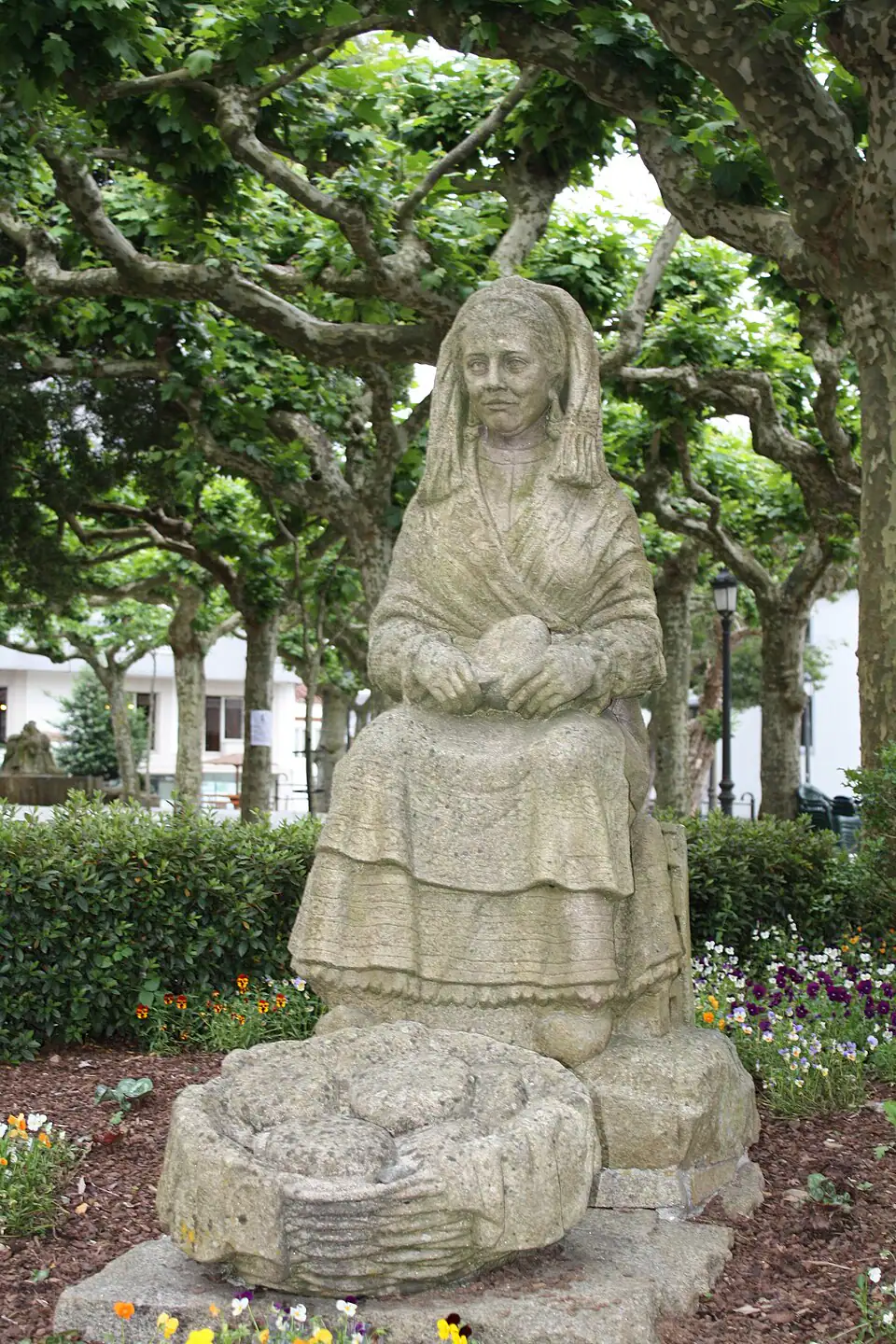
On Arzúa’s main square a granite woman sits on a crate with a basket of cheeses for sale at her feet. It is the town council’s tribute to the queixeiras, the women who made and sold the local cheese. That cheese, soft, milky and yellow-rinded, now has a protected name: Arzúa-Ulloa.
A farmhouse cheese
The PDO specification, published by the Xunta, explains that cheese was what Galician farmers made with milk that was neither drunk nor sold. It quotes Vicente Risco, who wrote in «Terra de Melide» (1933) that households usually made one or two cheeses a day, air-dried, washed to give them colour and wrapped in a cloth.
Arzúa-Ulloa brings under one name cheeses traditionally known as Arzúa, Ulla, A Ulloa, Curtis, Chantada, Friol or Lugo cheese. Production was centred mainly in south-east A Coruña (Sobrado, Curtis, Arzúa and Melide), western Lugo (Palas, Antas de Ulla and Monterroso) and part of the Deza area in Pontevedra.
The specification mentions the cheese fairs of Arzúa, Melide, Monterroso, Silleda, Friol, Lalín and Curtis, and the work of the veterinarian Carlos Compairé, whose «La fabricación de queso en Galicia» (1966) described the very large Ulloa cheese area.
From Galician quality product to PDO
On 23 February 1989 Arzúa cheese received the «Galician quality product» label, with a provisional governing body. According to the Xunta’s data sheet, an order of 20 October 1995 provisionally recognised the Queixo de Arzúa-Ulloa designation of origin (DOG, 7 November 1995).
The European Union registered it as a protected designation of origin under Regulation (EU) 20/2010 of 12 January 2010, and its current rules date from 2017. The regulatory council is based in Melide.
On 31 December 2025 there were 703 registered farmers and 15 cheese dairies; that year 5,140,082 kg of cheese were certified, with an estimated value of 41 million euros.
The PDO specification recalls that the cheese came from the milk left over at home: one or two were made a day.
Three types of cheese
Arzúa-Ulloa: soft paste, raw or pasteurised milk, ripened for at least six days. Lens-shaped or cylindrical with rounded edges, 0.5 to 3.5 kg and 100 to 260 mm across. Thin, elastic, shiny yellow rind; paste between ivory white and pale yellow, with few holes. It smells of milk, butter and yoghurt, with hints of vanilla, cream and walnut; the taste is slightly salty with medium to low acidity.
Arzúa-Ulloa de granja (farmhouse): as above, but made only with milk from the farm’s own cows.
Arzúa-Ulloa curado (aged): also known as cheese «de la nabiza», «from turnip time» or «of the year». It ripens for at least six months, weighs 0.5 to 2 kg and has an intense yellow, very compact, hard paste with a very strong buttery aroma and a peppery touch.
How it is made
Whole milk is used from Rubia Gallega, Brown Swiss and Friesian cows or their crosses, fed mainly on fodder grown on the farm and, when the weather allows, on pasture. Any standardisation of the milk is forbidden.
The milk is curdled at 30–35 ºC for 30 to 75 minutes. The curd is cut into pieces the size of a grain of maize and washed with water to lower its acidity; it is then moulded, pressed and salted, in the vat or in brine for no more than 24 hours. It ripens in rooms at 75 to 90 % humidity and below 15 ºC, being turned and cleaned.
Every cheese carries a numbered label of the designation, checked by the control body.
The area: the heart of Galicia
The milk and cheese come from 32 municipalities. In A Coruña: Arzúa, Boimorto, O Pino, Touro, Curtis, Vilasantar, Melide, Santiso, Sobrado, Toques, Frades, Mesía, Ordes, Oroso, Boqueixón and Vedra. In Lugo: Antas de Ulla, Monterroso, Palas de Rei, Carballedo, Chantada, Taboada, Friol, Guntín and Portomarín. In Pontevedra: Agolada, Dozón, Lalín, Rodeiro, Silleda, Vila de Cruces and A Estrada.
The specification links the cheese to a land of gentle valleys, much of it above 300 m, with an average temperature just under 12 ºC and 1,200 to 1,700 mm of rain a year: a landscape of meadows and pasture on small family farms. Many of the Camino Francés towns between Portomarín and O Pino lie inside the area.
Arzúa’s Festa do Queixo
According to the Concello de Arzúa, the Festa do Queixo is held on the first weekend of March and began in 1976; it is a festival of tourist interest organised by the council, with a fair, exhibitions, workshops and free shows.
Turismo de Galicia adds stalls where producers show and sell fresh and aged cheeses, a tapas and pintxos contest in the town’s bars with the hospitality association and the PDO, concerts, theatre and a workshop where children make cheese.
The rest of the year Arzúa’s market is held on the 8th and 22nd of each month, and the town has the granite monument to the Queixeiras by Fernando García Blanco (1984).
Arzúa on the Camino Francés
Arzúa is the end of the Palas de Rei → Arzúa stage and the start of the Arzúa → O Pedrouzo stage of the Camino Francés. More background in the history of Arzúa.
Frequently asked questions
What is Arzúa-Ulloa cheese?
A soft Galician cow’s-milk cheese with protected designation of origin. There are also farmhouse and aged versions.
Since when is it a PDO?
It was provisionally recognised in 1995 and registered by the EU as a PDO under Regulation (EU) 20/2010 of 12 January 2010.
Where is it made?
In 32 municipalities of central Galicia, in the provinces of A Coruña, Lugo and Pontevedra.
When is Arzúa’s Festa do Queixo?
On the first weekend of March. It has been held since 1976.
Is it made with raw milk?
It can be made with raw or pasteurised milk, always whole cow’s milk.
How long is it ripened?
At least six days; the aged version at least six months.
Sources (6)
- Xunta de Galicia (AGACAL): Pliego de condiciones DOP «Arzúa-Ulloa» (2009) (accessed 19 Nov 2026)
- Xunta de Galicia (AGACAL): Ficha técnica DOP Arzúa-Ulloa 2025 (accessed 19 Nov 2026)
- EUR-Lex: Reglamento (UE) n.º 20/2010 (registro DOP «Arzúa-Ulloa») (accessed 19 Nov 2026)
- Concello de Arzúa: Festas, feiras e romarías (accessed 19 Nov 2026)
- Turismo de Galicia: Festa do Queixo de Arzúa (accessed 19 Nov 2026)
- Concello de Arzúa (Descubre Arzúa): Monumento ás Queixeiras (accessed 19 Nov 2026)
- © Adrián Estévez (CC BY-SA 4.0)
- © P. Lameiro (CC BY-SA 3.0)