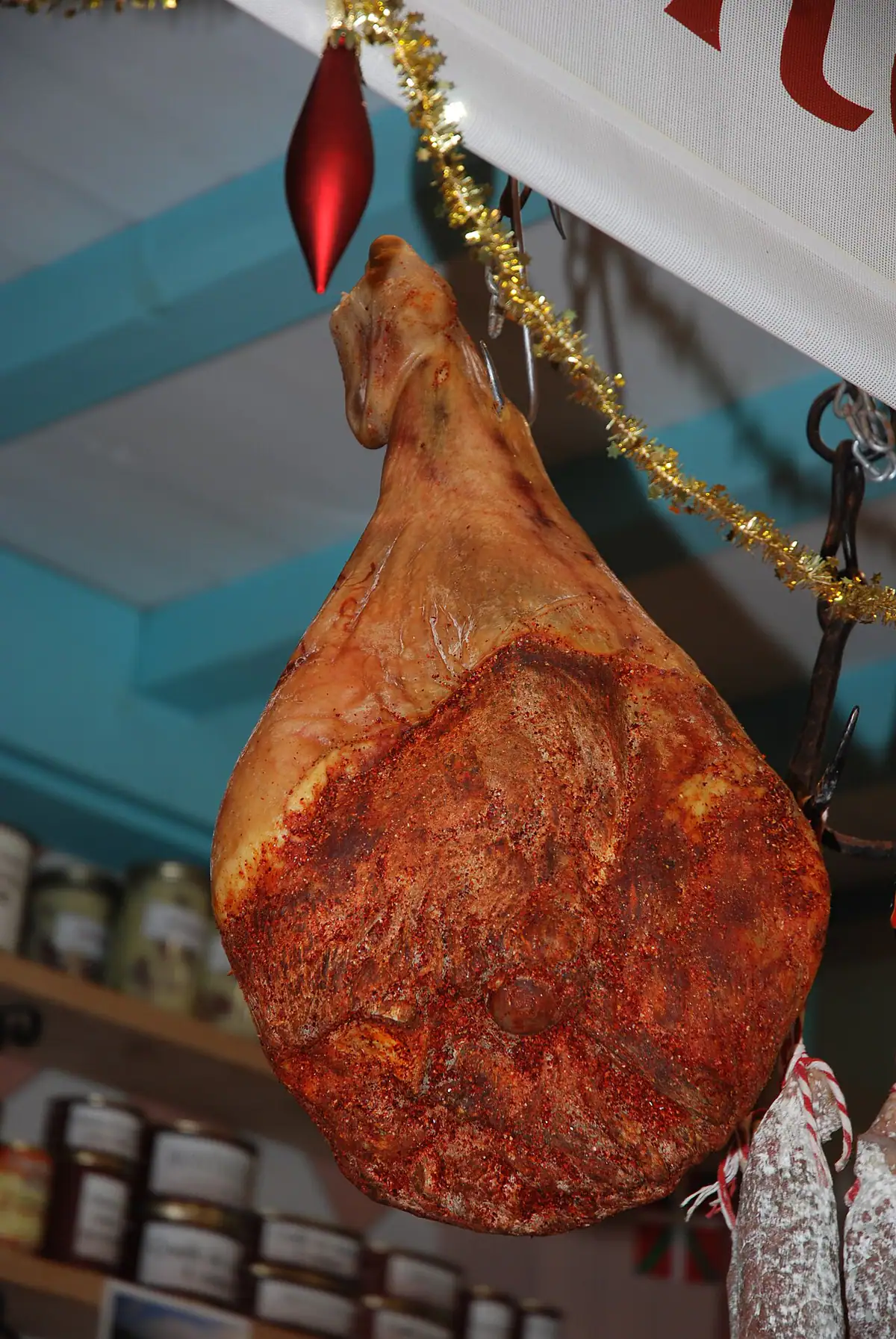
Jambon de Bayonne (PGI)
A bone-in cured ham, rounded in shape, lightly salted, tender and with white fat. It is salted only with salt from the Adour basin salt works and cured in that area, which takes in every commune of Pyrénées-Atlantiques, Saint-Jean-Pied-de-Port included.
What it is
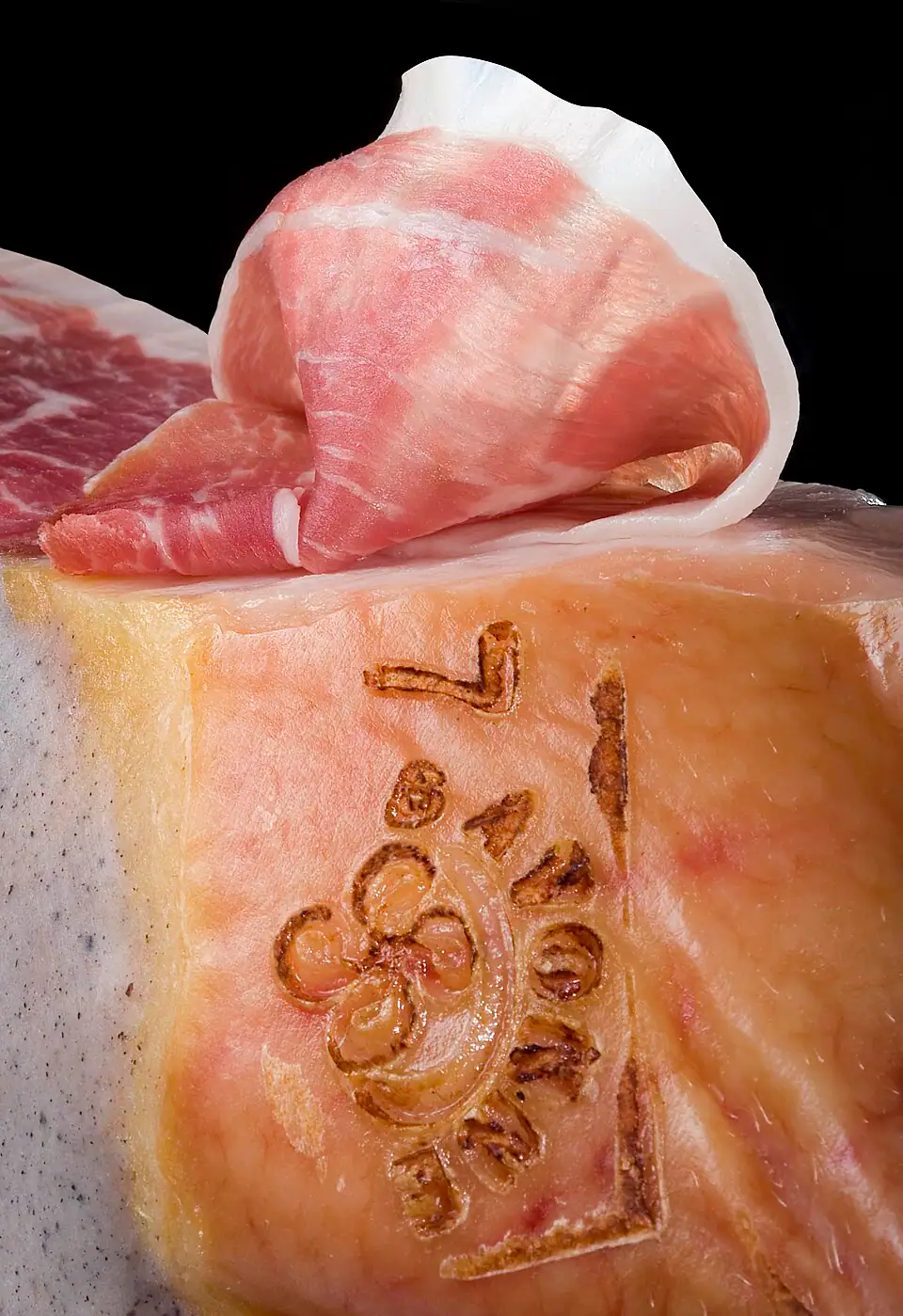
According to the specification, Jambon de Bayonne is a dry, lightly salted product: at most 7.5 % salt and 61 % moisture. It is rounded in shape; the lean meat, light to dark red and more or less marbled, is tender and moist, and the fat is white, firm and free of any rancid smell.
By the end it has lost at least 28 % of its weight. It carries a branded certification mark with the Bayonne logo and an individual number.
How it is made
It starts from a leg of at least 8.5 kg from pigs born, reared and slaughtered in 22 départements of south-western France. The leg is pressed to remove the blood, then rubbed and massaged with dry salt from the Adour basin salt works, with no brine injection; salting lasts at least 8 days at no more than 5 °C.
It then rests and dries in natural or regulated drying rooms. At least 7 months pass from salting to the end of drying, and hams cured for 9 months or more are coated with a fat paste («panne») before ageing.
In 1673 Froidour was already writing that the hams sold as «Bayonne hams» were hardly made in Bayonne at all: they came from Labourd, Lower Navarre and Soule.
The Adour basin
Salting, drying, slicing and packing all take place in the Adour basin. The specification stresses its climate: the foehn, a warm, dry south wind, can drop the humidity from 90 % to 20 % in a few hours, and Victor Hugo called it «this wind from Spain that drives you mad».
Underground lies a rock-salt deposit formed some 200 million years ago and worked since antiquity at Salies-de-Béarn, Bayonne-Mouguerre and Dax.
History
The specification says its fame in France and Europe was already established in the 16th century. It was the prize of the farmhouse larder and even served as currency in hard times and to pay tithes and rents. In 1828 the traveller Jouy noted a busy trade in Pau in «Bayonne» hams prepared at Salies.
A legend recorded in 1991 tells of a wounded boar that died by a salt spring and was found perfectly preserved by villagers the following summer. The EU registered it as a PGI in 1998 under Regulation (EC) No 2139/98.
In Saint-Jean-Pied-de-Port
Saint-Jean-Pied-de-Port lies inside the processing area, which covers all of Pyrénées-Atlantiques; Bayonne is about 41 km north-west as the crow flies. Before the stage to Roncesvalles on the Camino Francés, check the map for where to buy it.
Frequently asked questions
Is Jambon de Bayonne made in Bayonne?
It is cured throughout the Adour basin, not only in Bayonne. As early as 1673 Froidour wrote that few were made in Bayonne and that they came from Labourd, Lower Navarre and Soule.
How long is it cured?
At least 7 months from salting to the end of drying, losing at least 28 % of its weight.
Is Saint-Jean-Pied-de-Port in the area?
Yes: the processing area includes every commune of Pyrénées-Atlantiques.
Sources (4)
- INAO / BO-Agri: Cahier des charges de l’IGP «Jambon de Bayonne» (arrêté du 8 juillet 2026) (accessed 20 Nov 2026)
- INAO: ficha del producto «Jambon de Bayonne» (accessed 20 Nov 2026)
- Comisión Europea, eAmbrosia: Jambon de Bayonne (IGP, PGI-FR-0031) (accessed 20 Nov 2026)
- EUR-Lex: Reglamento (CE) n.º 2139/98 de la Comisión, de 6 de octubre de 1998 (accessed 20 Nov 2026)
- © Harrieta171 (CC BY-SA 3.0)
- © Jambon de Bayonne (CC BY-SA 4.0)