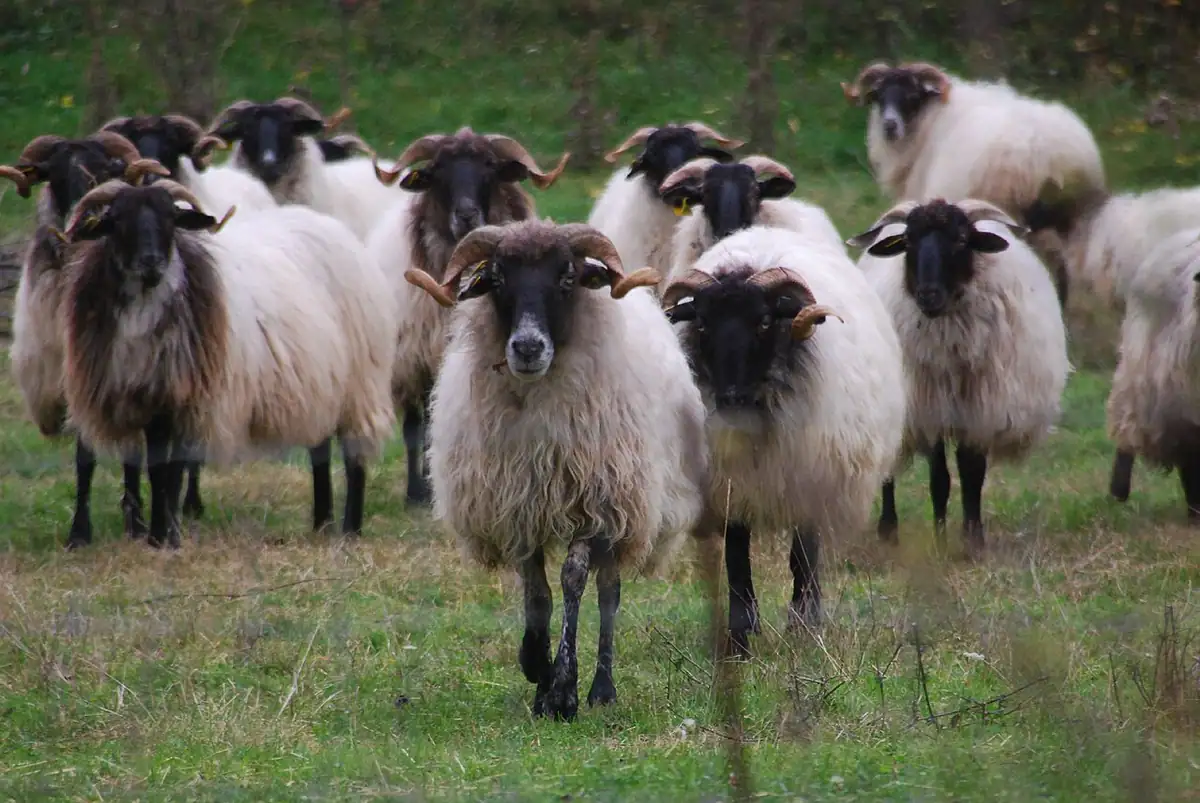
Cordero de Navarra (PGI)
Tender, juicy, pale pink meat from lambs of Navarre’s two native breeds, the Navarra and the Lacha. It is sold only fresh, as milk-fed «lechal» or as «ternasco», and the rearing area includes the Esteribar valley, Zubiri’s, on the Camino Francés.
Lechal and ternasco
The PGI protects the fresh meat of purebred Navarra and Lacha lambs. The «lechal», of either breed, is suckled only on its mother’s milk until slaughter, at 45 days at most, with a carcass of 5 to 8 kg for the Lacha and 6 to 8 kg for the Navarra. Its meat is tender, very juicy and soft-textured.
The «ternasco» is Navarra breed only: it suckles for at least 45 days and then eats cereal straw and a feed of cereals and legumes, up to 110 days at most and a carcass of 9 to 12 kg. Its meat begins to show marbling. In both cases the meat is pale pink with a light or medium fat cover.
Where they are raised
The specification lists each breed’s area municipality by municipality. Navarra-breed lambs may be born and raised across 87 % of Navarre (9,021 km²), from the Pyrenees, with Esteribar, Burguete and Roncesvalles, to the Pamplona basin, Tierra Estella and the Ribera. The Lacha covers 39 % (4,011 km²), in the north-west, the Pyrenees and some municipalities of the Pamplona Basin and Tierra Estella.
Most Lacha flocks, 86 %, practise «trasterminancia»: short moves between the valley and nearby hills, using common pastures in summer and autumn. Navarra-breed flocks used transhumance, vertical or long-distance, although short moves and staying put now prevail.
Milk-fed lamb drinks only its mother’s milk until slaughter, at 45 days at most: the specification bans formula milk.
From the Roncal to the Bardenas
The Navarra breed has also been called «Roncalesa». According to the specification, the Roncal Pyrenees seem to be where it spread across Navarre from, driven by transhumance: flocks came down in winter to the pastures of the Bardenas Reales, where they joined those of Urbasa, Andía and Lókiz. Some of those drove roads are still kept and used.
The breed began to be defined in the mid-19th century, and the 1913 National Livestock Show memoir already speaks of the «raza Lacha Navarra». The PGI was protected nationally in 2002 and registered by the EU in 2008 (file PGI-ES-0212).
Zubiri, in the Esteribar valley
Zubiri, in the Esteribar valley, lies inside the rearing area of both breeds, as do Burguete and Roncesvalles; Pamplona and most villages of the Camino Francés in Navarre lie in that of the Navarra breed. Check the map for where to eat lamb along the stage.
Frequently asked questions
What is the difference between lechal and ternasco?
Lechal drinks only its mother’s milk and is slaughtered at 45 days at most; ternasco, Navarra breed only, suckles for at least 45 days, then eats straw and cereal feed, up to 110 days.
Which breeds are used?
Navarre’s two native breeds, the Navarra and the Lacha, always purebred.
Is it sold frozen?
No: the PGI covers the meat for fresh consumption only.
Sources (3)
- MAPA: Pliego de condiciones IGP «Cordero de Navarra» o «Nafarroako Arkumea» (en vigor desde el 10 de diciembre de 2021) (accessed 20 Nov 2026)
- MAPA: Listado de DOP, IGP y ETG españolas registradas en la UE (2 de julio de 2026) (accessed 20 Nov 2026)
- Comisión Europea: eAmbrosia, registro de indicaciones geográficas (expediente PGI-ES-0212) (accessed 20 Nov 2026)
- © Josemari Gutiérrez (CC BY-SA 4.0)