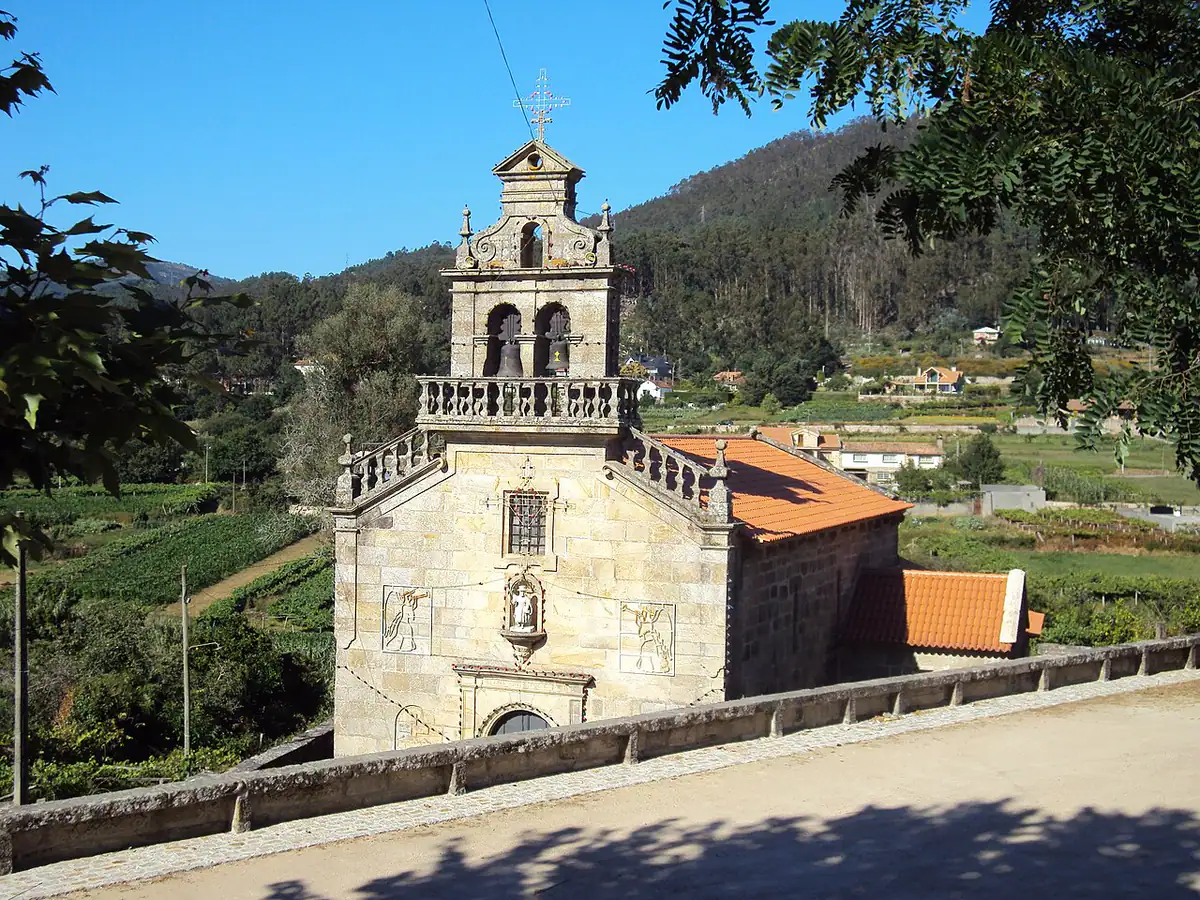
Church of Santiago de Parada
The church of Santiago de Parada is, according to the Concello de Nigrán, the only example of Romanesque art that survives in the municipality and one of the few in the Val Miñor. It is a fine example of 13th-century rural late Romanesque.
History
The church shows later alterations to the main front and additions on the south side, but its Romanesque fabric is almost intact. The apse walls once had frescoes, perhaps from the 16th century, showing a Crucifixion with Christ and part of the Virgin and, lower down, St James and St Peter. According to the Concello, they were removed during the restoration of the 1960s.
Exterior
It is a single-nave church ending in a semicircular apse. The plain exterior is broken only by two arrow-slit windows on each side of the nave and two more in the apse. The one on the north side, the only one fully visible, keeps billet and moulding decoration over a round arch on two columns with foliage capitals.
The only Romanesque doorway left is on the north front: a slightly pointed, splayed round arch whose archivolts are decorated with lines of billets, balls and six-petalled flowers, on two plain columns with foliage capitals. More six-petalled flowers beside the windows and varied corbels, some shaped like cattle heads, complete this front. Remains of the old south doorway’s decoration survive in the side chapel of the Virxe da Saúde.
Its Romanesque fabric survives almost intact, above all on the north front.
Interior
The interior is also plain, with a continuous billet band along the nave and brackets that must have carried a structure similar to today’s choir; the Concello believes the original roof was of timber, as it is now. The most interesting part is the chancel: a wide, slightly pointed triumphal arch decorated with balls and mouldings leads to the straight bay, covered by another arch on columns, with a half-dome at the end.
On either side are the windows, with round arches on columns with foliage and animal capitals; one shows an animal that could be a lamb, an image linked to the Eucharist. A third window at the end, with no counterpart outside, holds a polychrome stone figure of St James, the parish patron.
Getting there from the Camino
The church is in the parish of Parada, in the municipality of Nigrán, which includes A Ramallosa on the Portuguese Coastal Way. According to the Concello, interior visits depend on the needs of worship.
What to see nearby



Frequently asked questions
Are there other Romanesque churches in Nigrán?
No. According to the Concello, Santiago de Parada is the only Romanesque building that survives in the municipality.
What can be seen inside?
The chancel with its pointed triumphal arch, half-dome and polychrome stone figure of St James.
Sources (1)
- Concello de Nigrán, Turismo: Igrexa de Parada (accessed 19 Nov 2026)
- © HombreDHojalata (CC BY-SA 2.0)