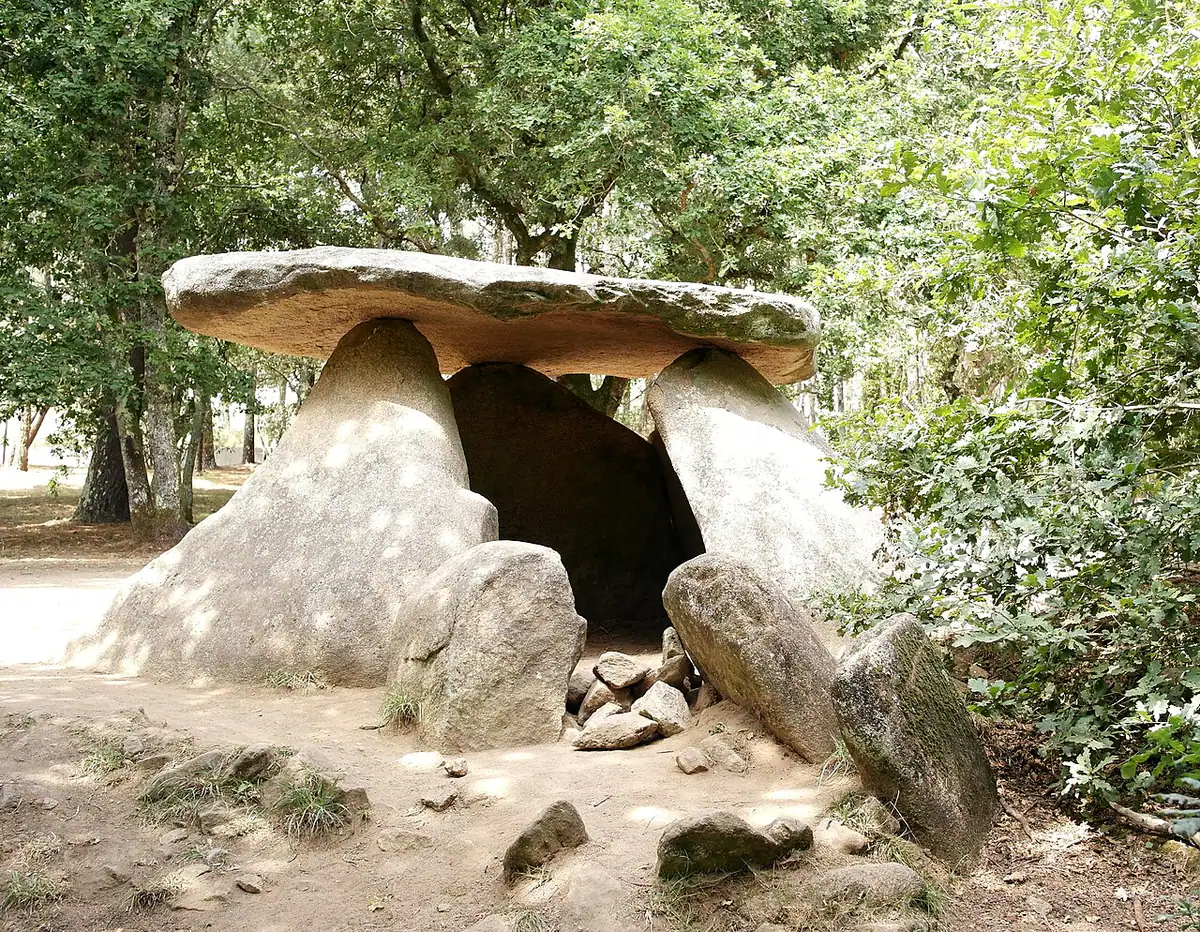
Dolmen de Axeitos (Ribeira)
The dolmen of Axeitos, also called Pedra do Mouro, is according to the Concello de Ribeira one of the main megalithic monuments in Galicia and one of the municipality’s first tourist attractions. It is a Site of Cultural Interest.
The monument
The mound is crowned by a great slab and formed by seven upright orthostats that enclose the burial chamber. In front opens a passage. According to the Concello’s tourism website it is marked by two loose stones; a municipal document for schools speaks of three passage slabs.
It belongs to the so-called passage graves: a chamber where the dead would rest and a corridor leading to it. Dolmens and mounds had a funerary purpose, often collective. The same municipal document gives it an age of between 3,600 and 4,000 years.
Engravings and idols
Inside, two engravings with geometric or anthropomorphic motifs can be seen. Outside, traces of idol representations were found, such as small sculptures made of rounded pebbles.
A great capstone crowns the burial chamber, formed by seven upright orthostats.
Visiting
According to the Concello, access is suitable for people with reduced mobility and visual impairment. The visit is free, unguided and takes about 15 minutes.
How to get there from the Camino
The dolmen is in the parish of Oleiros, in the municipality of Ribeira. It is reached by a turn-off from the AC-303 road between Oleiros and Olveira. Ribeira is the starting point of the Camino da Orixe, which begins at the Corrubedo lighthouse.
What to see nearby


Frequently asked questions
Why is it called Pedra do Mouro?
It is its other popular name, according to the Concello de Ribeira.
Can it be visited with reduced mobility?
Yes, the Concello lists it as accessible.
Sources (3)
- Concello de Ribeira, Turismo: Dolmen de Axeitos (accessed 19 Nov 2026)
- Concello de Ribeira: Itinerarios para centros de ensino (PDF) (accessed 19 Nov 2026)
- Concello de Ribeira, Turismo: Camino de Santiago «El Origen» (accessed 19 Nov 2026)
- © Froaringus (CC BY-SA 4.0)