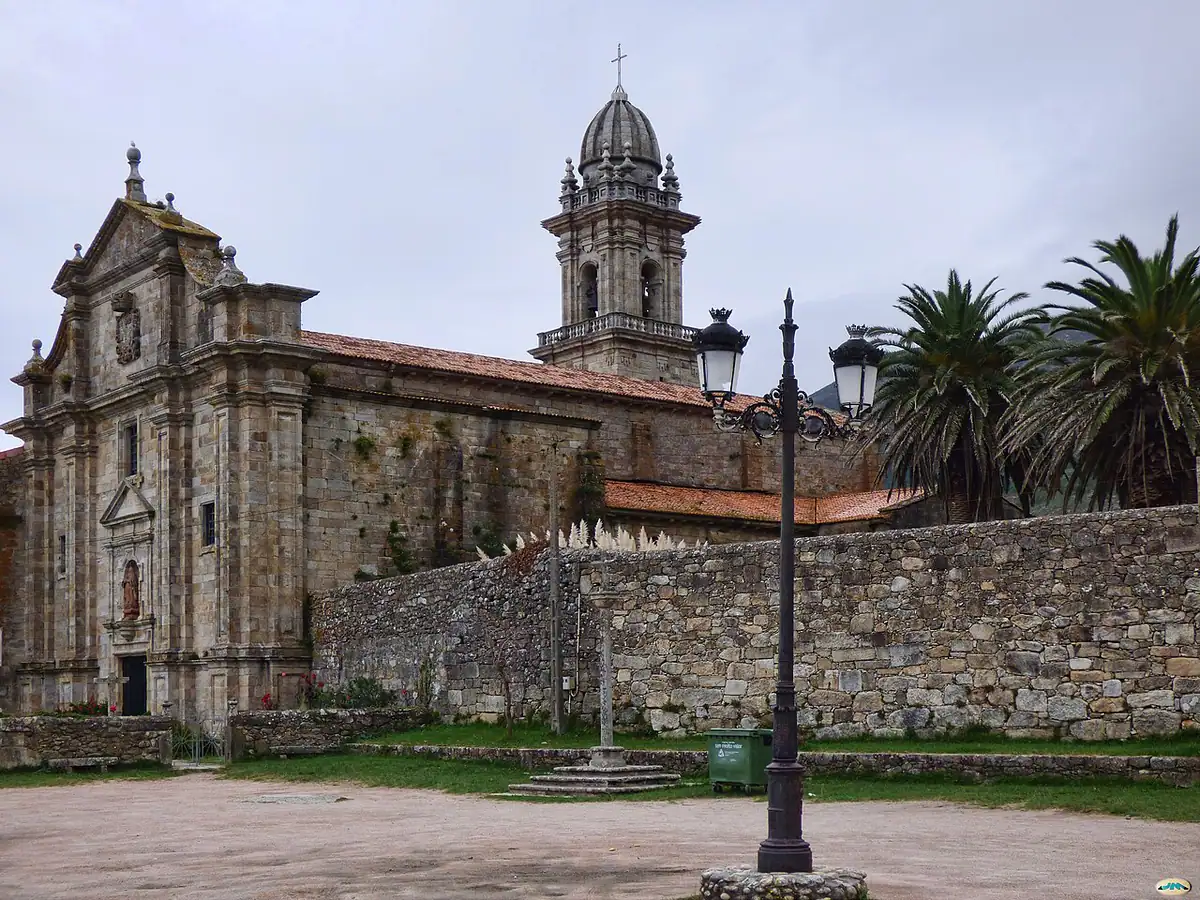
Monastery of Santa María de Oia
Facing the Atlantic on a rugged coast, the monastery of Santa María de Oia is, according to the Concello, the only Cistercian monastery in Europe on the shore of the ocean. The village grew up around it, and its history is that of the municipality itself.
Origins
The first written reference is a charter of 1137 in which Alfonso VII granted the early monastery of Oia and its abbot Don Pedro half the churches of Erizana (today’s Baiona) and A Guarda, and all those of Mougás, Pedornes, Burgueira, Loureza and O Rosal. Three Benedictine communities in the area merged under Don Pedro and adopted the Cistercian rule in 1185.
Frequent pirate attacks and the move to the Cistercian order led to a new monastery and church closer to the coast, conceived as a fortress and finished around the first half of the 13th century. Its domain came to stretch as far as Lisbon.
The artillery monks
At the end of the 15th century, during the war with Portugal, Pedro Madruga took and sacked the monastery; the monks returned in 1480 and later joined the Cistercian Congregation of Castile, which made new building work possible. The monks were bound to protect the coast, and a Royal Provision of 1580 records their company of soldiers.
Their most famous exploit came in 1624, when they turned their artillery on Turkish corsairs. These feats of arms led Philip IV to confirm the church’s title of Santa María la Real de Oya and that of Imperial and Royal Monastery.
The only Cistercian monastery in Europe on the ocean shore, according to the Concello de Oia.
Disentailment and the 20th century
Mendizábal’s Disentailment (1835) ended Cistercian life and the complex passed into private hands. In 1838 the parish of Santa María was created and the monastic church became the parish church.
In the 20th century the building was leased to Portuguese Jesuits, who opened a school: the Concello places their arrival in the 1920s and their departure in 1932; the tourist office gives 1910 to 1931. During the Civil War it was a prison; according to the Concello, mainly for Catalan prisoners, who left inscriptions on the walls of the Jesuits’ chapel.
Architecture
Highlights are the defensive wall, the Patio de Armas, the baroque tower and the two cloisters: the regular or Processions cloister and the Patio das Laranxeiras. In the 16th century the upper choir was built and a storey added to the cloister; in the 17th the precinct wall and the beach wall went up, and in the 18th the bell tower, the present façade and the ranges of the Patio das Laranxeiras.
The 12th–13th-century church keeps its Cistercian Gothic interior behind a classicist baroque façade presided over by the Virgen del Mar, patron of the municipality. Inside, note the chapels and altarpieces, the vaulted upper choir, the stone stairway in the transept and the triumphal arch bearing the arms of military orders.
Visiting
The monastery is privately owned and the tourist office lists it as temporarily closed; the church serves as the parish church. Address: rúa do Párroco Don Claudio Rodal Fandiño, 5. Telephone: 695 482 786.
Beside it lies the Arrabal quarter, which grew up in the monastery’s shelter, with narrow streets, houses with outside stairs and Praza Centinela, a lookout over the harbour and the monastery.
From the Camino
It is in Oia, end of the A Guarda–Oia stage (16.5 km) of the Camino Portugués da Costa and start of the Oia–Baiona stage (17.8 km).
Frequently asked questions
Can you visit it?
The monastery is private and listed as temporarily closed; the church is a parish church.
Who were the artillery monks?
The monks of Oia, bound to defend the coast, who in 1624 turned their artillery on Turkish corsairs.
Sources (4)
- Concello de Oia: Historia (accessed 19 Nov 2026)
- Concello de Oia: Patrimonio histórico (accessed 19 Nov 2026)
- Turismo Concello de Oia: Monasterio de Santa María de Oia (accessed 19 Nov 2026)
- Turismo Concello de Oia: Barrio del Arrabal (accessed 19 Nov 2026)
- © juantiagues (CC BY-SA 2.0)