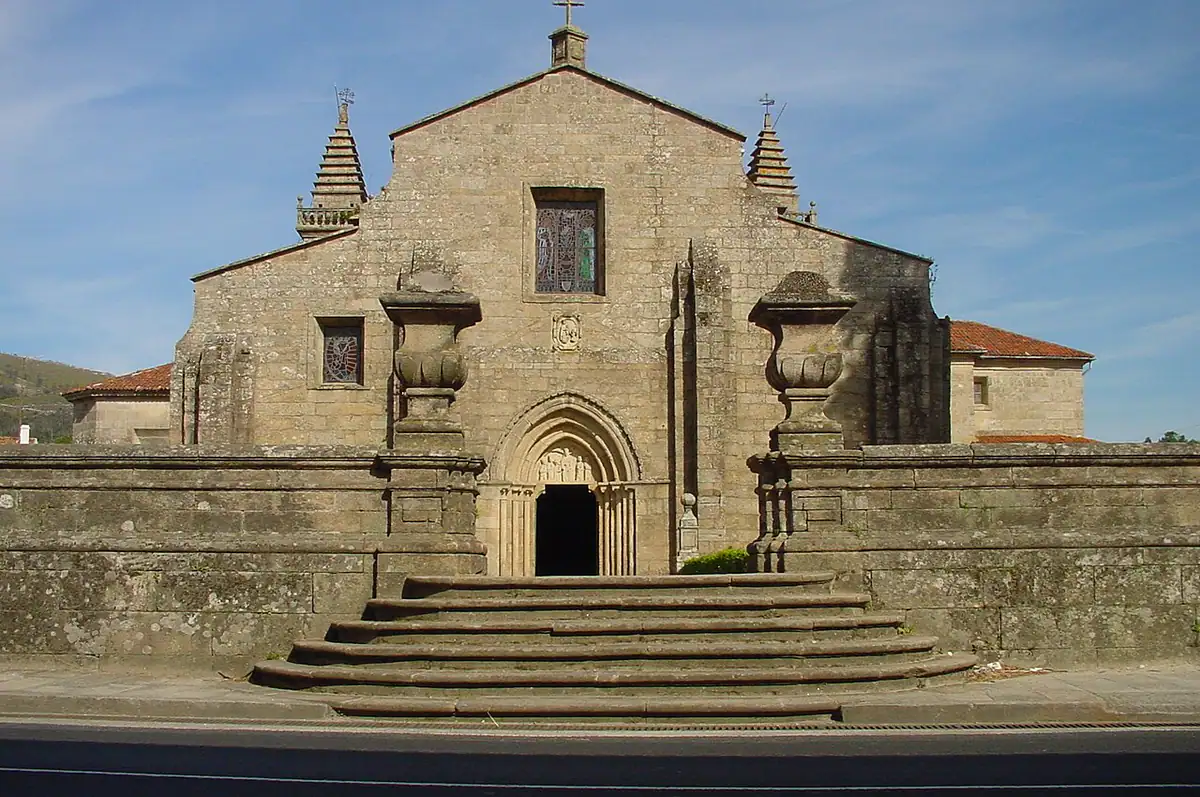
Church of Santa María de Iria Flavia
Before Compostela had its own bishop, the see was here. Santa María de Iria Flavia, a kilometre from the centre of Padrón, stands on the site of a Roman town and was a bishop’s see until 1095. Beside its walls, the cemetery of Adina holds the grave of Camilo José Cela and the memory of Rosalía de Castro.
History: the see of the bishops of Iria
The decree protecting the site recalls that Iria Flavia was an important urban centre and a Roman staging post on the Antonine Itinerary. The Concello de Padrón presents it as one of the oldest churches in Galicia and regards it as the world’s first church dedicated to Mary; when the original basilica was built is not known for certain.
The earliest documentary evidence of Iria as a bishop’s see dates from the 6th century. The parish reproduces an 1885 description that reviews its bishops: Andrés, in the time of the Suebian king Miro, took part in the councils of Lugo and Braga, and Domingo attended the Third Council of Toledo in 589.
The bishopric of Iria played a central part in the discovery of the Apostle’s tomb: it was Bishop Teodomiro who reported the find around the year 820. From then on his successors added the title of Santiago to that of Iria, until in 1095, by grant of Pope Urban II, the Cluniac Dalmatius took the title of bishop of Compostela and the see stayed in Santiago.
Diego Xelmírez restored the church and established a chapter of twelve clerics headed by a prior. It remained a collegiate church, styled the second see of Compostela, until the Concordat of 1851 abolished the chapter and turned it into a parish church. More context in the history of Padrón.
Architecture: stepped towers and a medieval doorway
According to the 1975 decree, the present church, with its stepped pyramidal towers, three broad naves and adjoining chapels, is a notable example of 17th-century architecture. Only the main doorway survives from the earlier building.
The 1885 description dates that doorway, with its splayed pointed arches on Romanesque columns, to around the 13th century. The rest was rebuilt at the expense of Archbishop Fray Antonio de Monroy, whose coat of arms can be seen in the church; the Concello dates the last rebuilding to the 18th century.
Valuable archaeological remains have turned up more than once beneath the floors and among the foundations, which the decree itself cites as proof of the site’s historical importance.
Rosalía de Castro lay in the cemetery of Adina from her death in 1885 until her remains were moved to Santiago.

What to see inside: tombs and altars
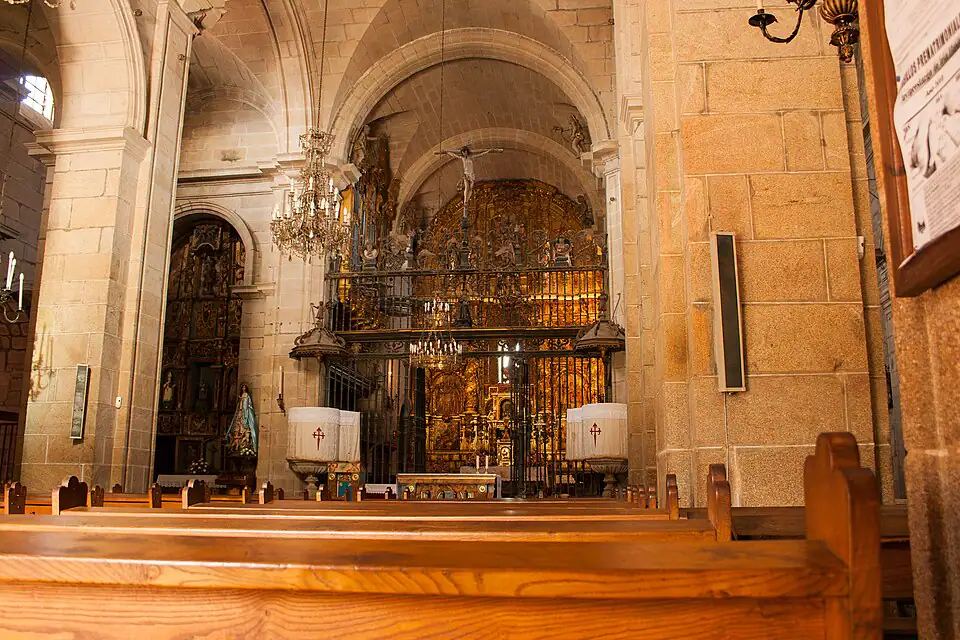
The 1885 text still works as a guide. By the first pillar of the south aisle, west of the altar of Saint Roch, tradition places the burial of twenty-eight prelates who took refuge in Iria during the Muslim invasion; Xelmírez mentions them in a deed of 1134.
In the main chapel an ancient stone image of the Virgin appearing to the Apostle James is venerated. In the sanctuary are the tomb of the Corpo Santo, a bishop of Iria who draws deep-rooted local devotion, and, opposite, that of Archbishop Rodrigo de Luna, who died in 1460, with his bust. At the west end opens the chapel founded in the 17th century by Alonso de la Peña y Rivas, a native of Padrón and bishop of Quito.
The cemetery of Adina: Rosalía and Cela
On the south side of the church lies the cemetery of Adina. According to the decree, it is also a late Roman and Suebian necropolis where large sarcophagi decorated with the Suebian stole, a schematic image of a figure in prayer, have been found. The Concello dates the anthropomorphic sarcophagi now in the churchyard to the 6th century.
Rosalía de Castro asked to be buried here. Her remains lay in Adina from her death in July 1885 until 1891, when they were moved to the Pantheon of Illustrious Galicians in the convent of Santo Domingo in Santiago; a memorial stone to her remains in the cemetery. The poet called it a «charming» graveyard of dark olive trees.
Within its walls stand two stone crosses and four centuries-old olive trees listed in the Catalogue of Outstanding Trees of Galicia. Beneath one of them is the grave of Camilo José Cela, born in Iria Flavia in 1916 and died in Madrid in 2002.
A protected ensemble since 1975
Decree 2494/1975 of 23 August declared the former collegiate church and its surroundings a national historic-artistic monument, with the agreement of the Archdiocese of Santiago. The protection covers the church, the cemetery of Adina and the canons’ houses opposite, which in 1975 served as the rectory and housed the Museum of Sacred Art of Iria Flavia.
Spain’s Historical Heritage Act 16/1985 turned such declarations into Bienes de Interés Cultural (BIC), the status the ensemble holds today.
Visiting: hours and tips
Admission is free, according to the Concello de Padrón, which does not publish fixed visiting hours. Groups can arrange a visit with the parish on +34 981 810 350 or at pastoralpadron@gmail.com, at least 24 hours in advance.
The Concello lists Mass on Saturdays at 19:00 and Sundays at 11:30; times may change, so check the parish website before you go. Visits pause during services.
The Ruta Rosaliana, linking places associated with Rosalía de Castro, passes through Iria.
Getting there from the Portuguese Way
The church is just under 1 km in a straight line north-east of the centre of Padrón, approx. 13 min on foot, in the direction of Santiago. The Portuguese Way runs through town: the Caldas de Reis → Padrón stage (18.8 km) ends in Padrón and the Padrón → Santiago de Compostela stage (25.2 km) starts there.
You can see it alongside the other sights on the map.
What to see nearby



Frequently asked questions
Why is Iria Flavia important?
It was a bishop’s see until 1095, when the title passed to Santiago. Its bishop Teodomiro reported the discovery of the Apostle’s tomb around the year 820.
What is the cemetery of Adina?
The graveyard beside the church, also a late Roman and Suebian necropolis. Rosalía de Castro once lay here and Camilo José Cela is buried here.
Is Rosalía de Castro buried in Iria Flavia?
Not any more. She lay in Adina from 1885 to 1891, when her remains were moved to the Pantheon of Illustrious Galicians in Santiago. A memorial stone remains.
Where is Camilo José Cela’s grave?
In the cemetery of Adina, beneath one of its centuries-old olive trees. Cela was born in Iria Flavia in 1916.
Is it a protected monument?
Yes. Decree 2494/1975 declared it a national historic-artistic monument with its surroundings, and Act 16/1985 turned that into BIC status.
Can you visit the inside?
Yes, admission is free. Groups should arrange their visit with the parish 24 hours ahead; check Mass times before you go.
How old is the church?
The 1975 decree describes it as a 17th-century building, except for the doorway, which comes from the earlier church.
Sources (8)
- BOE: Decreto 2494/1975, de 23 de agosto (ex Colegiata de Santa María de Iria Flavia, con su entorno) (accessed 18 Nov 2026)
- BOE: Ley 16/1985 del Patrimonio Histórico Español, disposición adicional primera (accessed 18 Nov 2026)
- Concello de Padrón (Padrón Turismo): Igrexa de Santa María a Maior de Iria Flavia (accessed 18 Nov 2026)
- Concello de Padrón (Padrón Turismo): Cemiterio de Adina de Iria Flavia (accessed 18 Nov 2026)
- Parroquias de Padrón (Arciprestazgo de Iria Flavia): Iria (texto de J. M. Fernández Sánchez y F. Freire Barreiro, 1885) (accessed 18 Nov 2026)
- Parroquias de Padrón: Visitas turísticas y atención a peregrinos (accessed 18 Nov 2026)
- Fundación Rosalía de Castro: Biografía (accessed 18 Nov 2026)
- Fundación Rosalía de Castro: A Casa-Museo (accessed 18 Nov 2026)
- © Padrón Turismo (CC BY-SA 4.0)
- © Iago Pillado (CC BY-SA 3.0)
- © Iago Pillado (CC BY-SA 3.0)