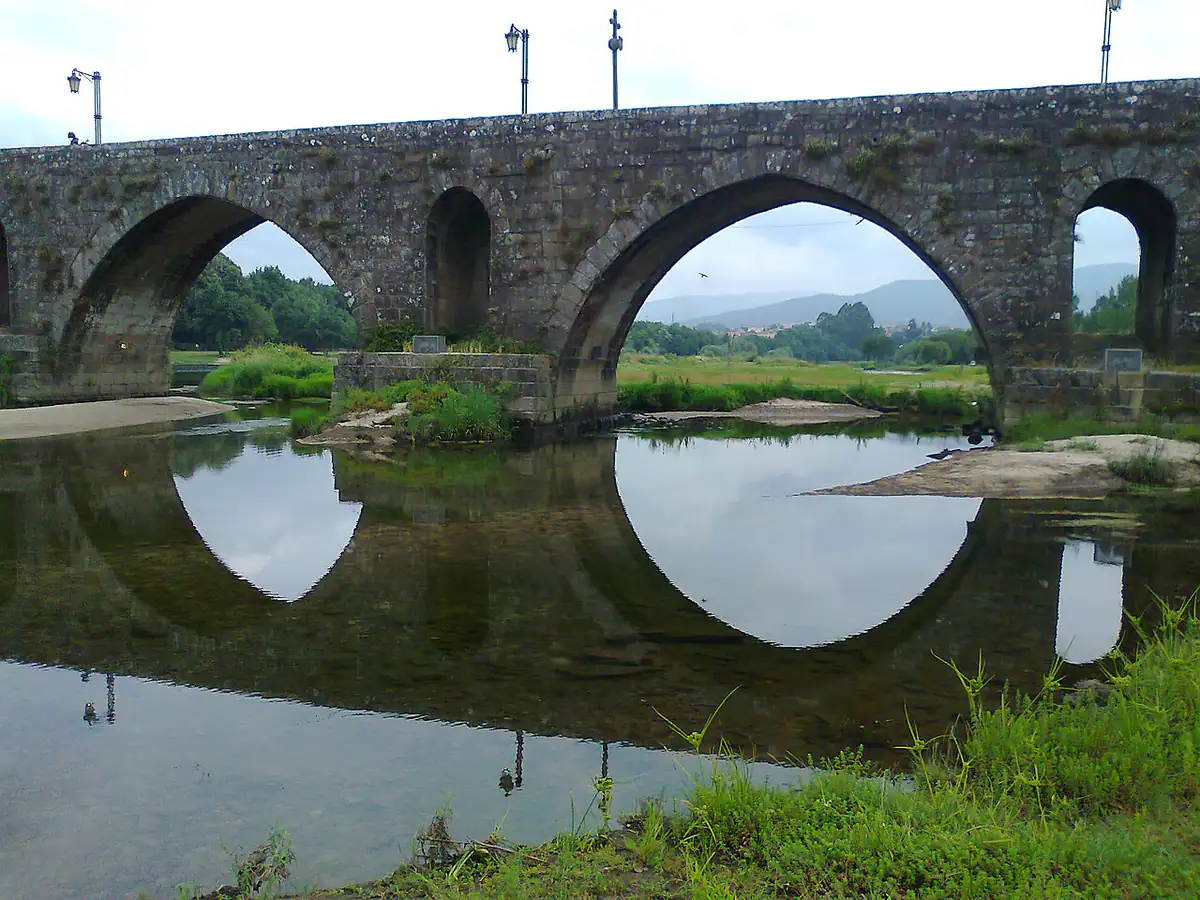
Roman and medieval bridge of Ponte de Lima
The emblem of Ponte de Lima is its bridge, which together with the river gave the town its name. It is really two bridges in a row: a long medieval section starting on the left bank, and what remains of the Roman bridge next to the far bank.
Two bridges in one
According to the municipality, the ensemble is made up of two bridges. The medieval section, the longer one, begins on the left bank and runs as far as the church of Santo António da Torre Velha, which it still spans with two arches. Then comes what is left of the Roman bridge: just five arches from the large arch that now stands on dry riverbed.
Going down beside the bridge you can also see the foundations of the Torre Velha, perhaps the first tower of the town's medieval defences.
The Roman section
The Roman bridge probably dates from the 1st century, since that is when one of the military roads of the old Conventus Bracaraugustanus was laid out: the Via XIX, ordered by Emperor Augustus, which linked Braga with Astorga.
Until the end of the Middle Ages it was the only safe crossing along the whole course of the river Lima, according to the municipal council.
The medieval section
Its origin is harder to date. It may go back at least to the reigns of Pedro I and Fernando, given its direct link with the walls and towers that fortified the town, completed in 1370; or even to Dinis, since documents mention a bridge that at the time might also have been made of wood.
What is certain is that it existed under Manuel I: in 1504 the king had it repaved and had merlons added as decoration, as they no longer served any defensive purpose. For the municipal council, this bridge was until the end of the Middle Ages the only safe crossing along the whole course of the Lima, hence its importance throughout the Alto Minho.
Across the river: Além da Ponte
Crossing the river you reach what locals call Além da Ponte, "beyond the bridge". There stand the chapel of the Anjo da Guarda, which the municipality cites as a national monument, and the church of Santo António da Torre Velha.
The bridge and the Portuguese Way
Since the Middle Ages Ponte de Lima has been an obligatory stop on the Portuguese Way, which continues from the town towards the Labruja hills. See the map.
What to see nearby


Frequently asked questions
Is the bridge at Ponte de Lima Roman?
Partly: next to the Além da Ponte bank there are five arches of the Roman bridge, probably 1st-century; the longer section is medieval.
Why is the town called Ponte de Lima?
Because of its bridge: Queen Teresa already called it «Terra de Ponte» in the 1125 charter.
Sources (5)
- Visite Ponte de Lima (Município): Ponte Romana e Ponte Medieval (accessed 20 Nov 2026)
- Visite Ponte de Lima (Município): Património Religioso da Vila e da Além da Ponte (accessed 20 Nov 2026)
- Câmara Municipal de Ponte de Lima: Ponte de Lima (accessed 20 Nov 2026)
- Visite Ponte de Lima (Município): Caminho Português de Santiago (accessed 20 Nov 2026)
- Diário do Governo n.º 136, 23-06-1910: Decreto de 16 de junho de 1910 (monumentos nacionais; «Ponte do Lima — Ponte sobre o Lima») (accessed 20 Nov 2026)
- © GualdimG (CC BY-SA 4.0)