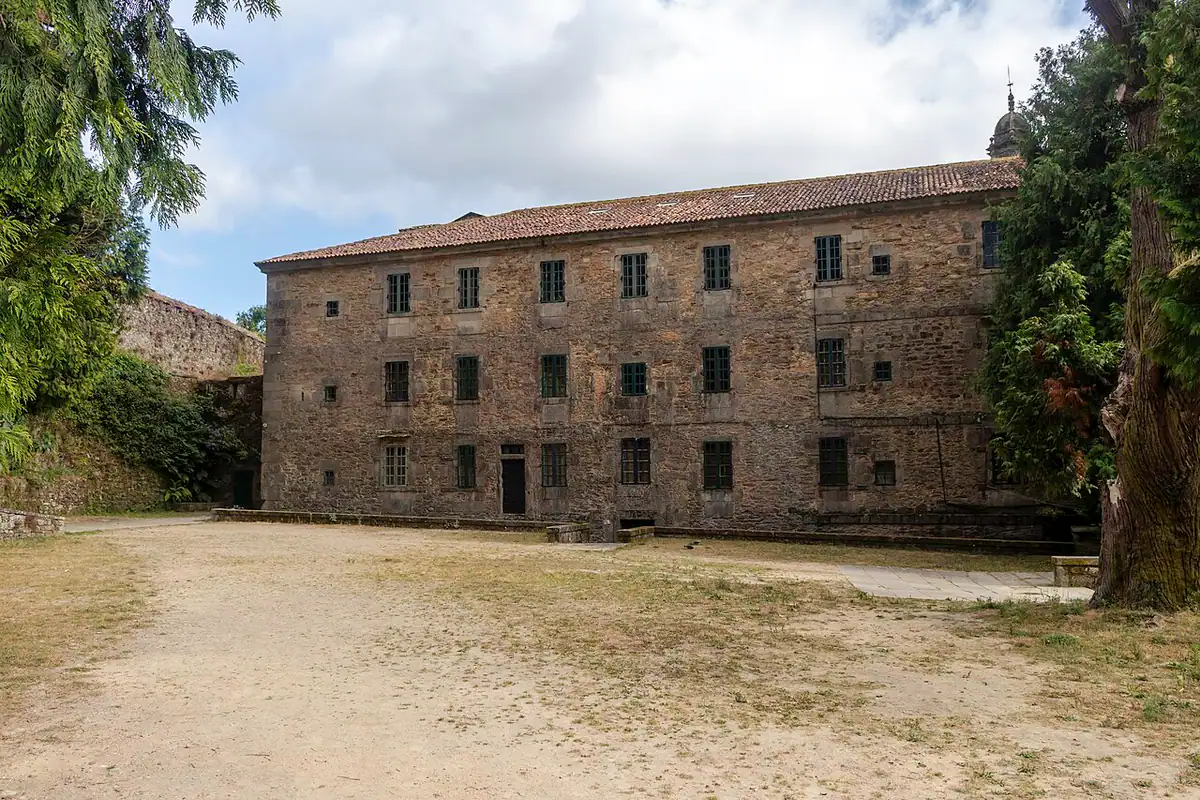
Convent of San Domingos de Bonaval, Galicia’s pantheon
Right where the Camino Francés crosses the old city wall at the Porta do Camiño, in Bonaval, stands the old Dominican convent of San Domingos. Its church holds the Pantheon of Illustrious Galicians, where Rosalía de Castro and Castelao rest, and since 1977 the convent has housed the Museo do Pobo Galego, with a striking triple spiral staircase.
History of the convent
It is a Dominican convent founded in the 13th century: according to Turespaña, the oldest document mentioning it dates from 1228, and it took the name of Santo Domingo in the 15th century. Although founded in the Middle Ages, much of the present building is later, and its façade is Baroque.
In 1912 it was declared a national monument; the Xunta’s official list of heritage assets records the church of San Domingos with that protection. In 1977 the city council handed the building over to the Museo do Pobo Galego, at the request of its then newly formed board.
The church and the triple staircase
The church is one of the largest in Santiago: basilican in plan, with three naves and three apses, in a style of transition from Romanesque to Gothic according to Turespaña; the city council’s leaflet calls it a “beautiful Gothic church”.
In the convent, the council highlights the “surprising” triple spiral staircase, one of the features museum visitors walk through.
On 25 May 1891 Rosalía de Castro’s remains arrived here: that was the birth of the Pantheon of Illustrious Galicians.
The Pantheon of Illustrious Galicians
Its history is told in the Galician Parliament’s own Law 5/2023. In 1891, on the initiative of Santiago’s Economic Society of Friends of the Country, the city council, the Galician Regionalist Association and a group of law students, and with the consent of Manuel Murguía and the writer’s family, it was agreed to move Rosalía de Castro’s remains from the cemetery of Adina in Iria Flavia. They reached the convent church on 25 May 1891; the Galician press of the day named the place the Pantheon of Illustrious Galicians.
In 1906 the regionalist leader Alfredo Brañas, who had died in 1900, was buried here. He was followed by the sculptor Francisco Asorey, who died and was buried in 1961; the poet Ramón Cabanillas, who died in 1959 and was buried in 1967; and the cartographer and mathematician Domingo Fontán, who died in 1866 and was buried in 1968. In 1984, by agreement of the Galician Parliament, came Alfonso Daniel Rodríguez Castelao, who died in Buenos Aires in 1950 and was moved from the Chacarita cemetery.
Under the dictatorship, the mass held here every 25 July, Galicia’s National Day, became a statement of Galician identity. The 2023 law recognises the Pantheon of Illustrious Galician Women and Men as a symbol of Galicia’s identity; the spaces it occupies belong to the Church and the city council.
Museo do Pobo Galego
The convent is the home of the Museo do Pobo Galego. The museum has its own website (museodopobo.gal); the official sources consulted for this article do not publish opening hours or prices, so check there before going.
Bonaval park
Next to the convent, San Domingos de Bonaval park combines the Dominicans’ old kitchen garden, an oak grove and a former cemetery. The city council recommends it for its “unmissable” views over the city.
Getting there from the Camino Francés
The Camino Francés enters the old town through the Porta do Camiño, after the Concheiros district and Rúa de San Pedro. According to the city council, this is the point in the vanished wall where pilgrims enter, and Bonaval lies right beside it.
The last day is the O Pedrouzo – Santiago de Compostela stage (19.4 km). See the map.
What to see nearby
-
ChurchProtected heritage (BIC)
Catedral de Santiago de Compostela


Frequently asked questions
Who is buried in the Pantheon of Illustrious Galicians?
Rosalía de Castro (since 1891), Alfredo Brañas (1906), Francisco Asorey (1961), Ramón Cabanillas (1967), Domingo Fontán (1968) and Castelao (1984).
When did Rosalía de Castro come to Bonaval?
On 25 May 1891, from the cemetery of Adina in Iria Flavia.
What is in the convent today?
The Museo do Pobo Galego, which has occupied it since the city council handed it over in 1977.
What is the triple staircase?
A triple spiral staircase in the convent that Santiago city council highlights as one of its most surprising features.
Is it close to the Camino?
Yes: it is beside the Porta do Camiño, where the Camino Francés enters the old town.
Sources (4)
- Parlamento de Galicia: Lei 5/2023, do 4 de agosto, do Panteón de Galegas e Galegos Ilustres (exposición de motivos, Lex.gal) (accessed 19 Nov 2026)
- Turespaña (spain.info): Convento de Santo Domingo de Bonaval (accessed 19 Nov 2026)
- Concello de Santiago (Santiago Turismo): folleto «Ruta monumental» (GL) (accessed 19 Nov 2026)
- Xunta de Galicia: Bens de Interese Cultural de Galicia (listaxe da Consellería de Cultura) (accessed 19 Nov 2026)
- © Bene Riobó (CC BY-SA 4.0)