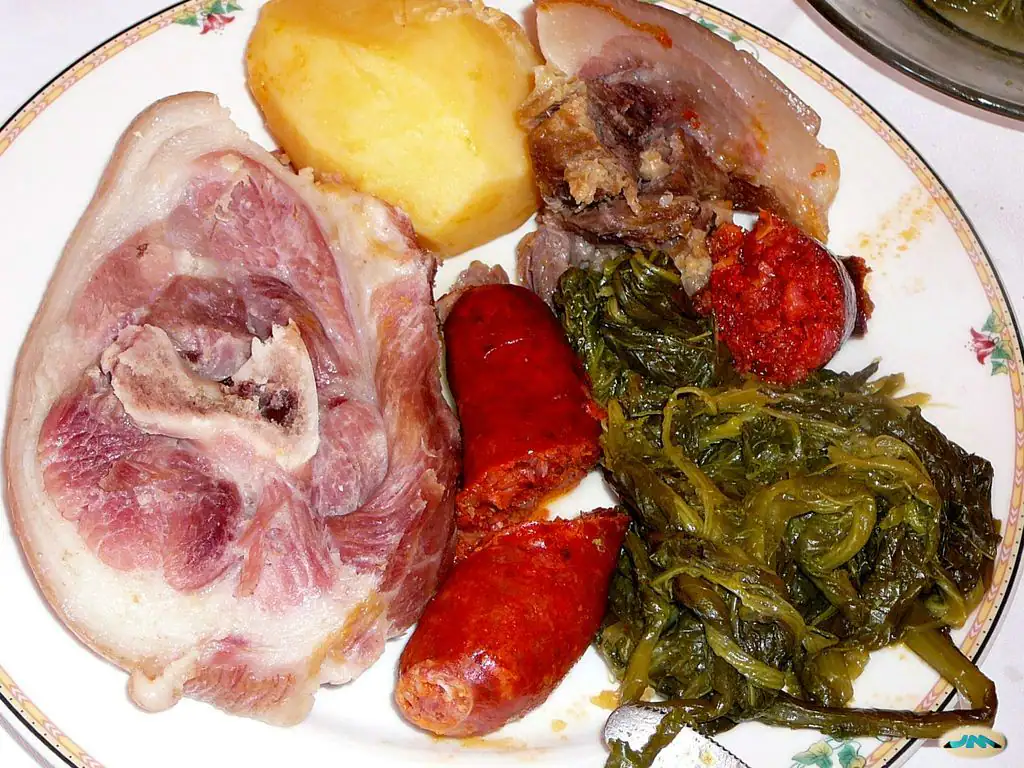
Lacón Galego: the Lacón Gallego PGI
Lacón is the pig’s foreleg, cured whole with its skin and trotter. In Galicia it is the heart of lacón con grelos and one of the meats in cocido. With a protected name, Lacón Gallego is reared, slaughtered and cured inside Galicia, and is never smoked.
The pig in the Galician home
The specification, published by the Xunta, explains that until recently the pig was one of the few sources of protein in rural Galicia, along with milk and eggs. Pigs were fed cabbage, turnips, grain and kitchen scraps, and everything to do with raising them was women’s work.
It also recalls the Celta breed, dominant in Galicia until the 1950s, and quotes the veterinarian Rof Codina, who wrote in 1932 that Chantada’s greatest livestock wealth was its Celta pigs. Rough sculptures of pigs and boars appear in the castro culture.
Slaughter took place in the cold months, as the saying «every pig gets its St Martin’s day» recalls, and lacón con grelos was a set dish in many areas on Christmas Eve or Carnival Sunday. A Royal Order of 22 May 1930 allowed slaughterhouses to kill all year round.
What protected lacón is like
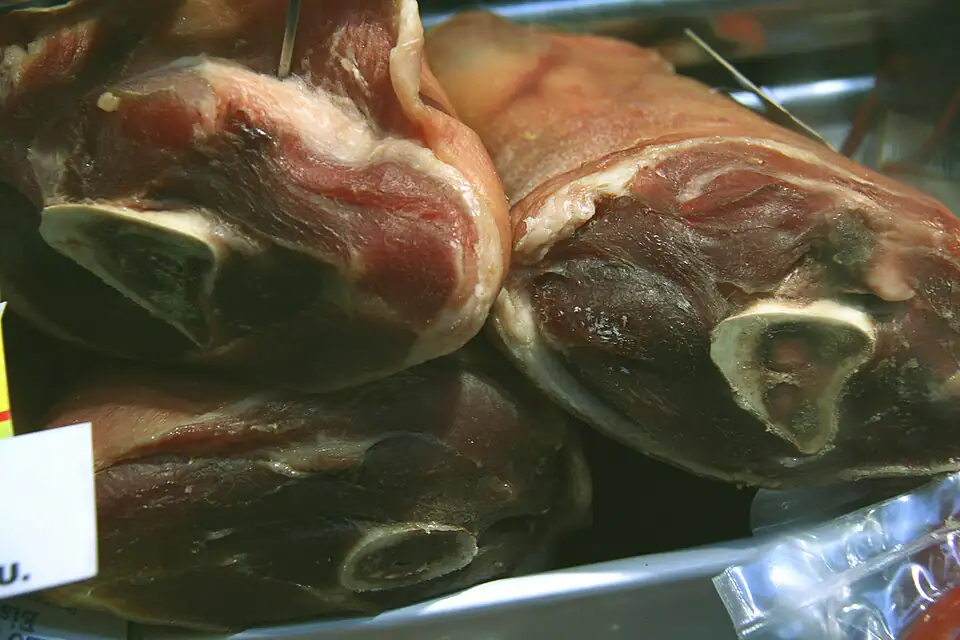
It is the pig’s foreleg: humerus, ulna, radius, carpus, metacarpus and phalanges with their muscles and fat. It is sold whole and rounded, with skin and trotter but without the hooves, weighing 3 to 5.5 kg.
When cut it is clean and glossy, with fat partly marbled into the muscle; the colour ranges from pink to purplish red. According to the specification its aroma is mild and its flavour lightly salted with a slightly sweet touch.
There are two categories: Lacón Gallego Tradicional, from pigs fed traditionally (cereals, acorns, chestnuts and tubers) in their last three months, and Lacón Gallego, from pigs fed on feed authorised and controlled by the regulatory council.
The specification recalls that lacón con grelos was a set dish in many parts of Galicia on Christmas Eve or Carnival Sunday.
Salt, rest and drying
The pigs are Celta, Large White, Landrace, Duroc and their crosses, plus crosses with Belgian White and Piétrain provided these do not exceed 25 %. Animals must be at least six months old and weigh 90 kg live, and they are butchered with the traditional round cut.
Salting lasts about one day per kilo of meat; the lacón is then washed in cold or lukewarm water. Next comes settling, at least seven days at 2–5 ºC and 80–90 % humidity so the salt spreads evenly, then drying or curing for at least fifteen days.
The whole process takes at least thirty days, and smoking is never allowed. Each piece carries a numbered seal and back label from the regulatory council.
From specific designation to PGI
According to the Xunta’s data sheet, an order of 7 February 1997 recognised it as a specific designation, and its rules, from November 1997, were ratified by the Spanish ministry in 1998. The EU registered it as a protected geographical indication by Regulation (EC) 898/2001 of 7 May 2001.
The production and processing area is all of Galicia; it is not a Santiago product, although the regulatory council is based in Santiago de Compostela, on Avenida do Camiño Francés. On 31 December 2025 there were 191 farms and 15 businesses registered; in 2025, 11,775 kg (3,115 pieces) were certified, with an estimated value of €80,000.
Lacón festivals (outside Santiago)
According to Turismo de Galicia, Lalín’s Festa do Cocido is a festival of international tourist interest; it is held on the Sunday before Carnival and its cocido includes lacón, ear, ribs and chorizo. The same guide lists Cuntis’s Festa do Lacón con Grelos among Galicia’s festivals of tourist interest. Neither is held in Santiago.
What to see nearby
In Santiago, the goal of the Camino is the Cathedral of Santiago; a step away is the Monastery of San Paio de Antealtares.
Santiago on the French Way
Santiago de Compostela is the end of the O Pedrouzo → Santiago stage and of the French Way. More background in the history of Santiago.
Frequently asked questions
What is lacón?
The pig’s foreleg, cured whole with its skin and trotter.
Is it a Santiago product?
No: the area is all of Galicia. Santiago is where the regulatory council is based.
Is Lacón Gallego smoked?
No. The specification never allows smoking.
How long is it cured?
At least 30 days across salting, washing, settling and drying.
What is traditional lacón?
Lacón from pigs fed cereals, acorns, chestnuts and tubers in their last three months.
Since when is it a PGI?
Since Regulation (EC) 898/2001 of 7 May 2001; from 1997 it was a specific designation.
Sources (5)
- Xunta de Galicia (AGACAL): Pliego de condiciones IGP «Lacón Gallego» (accessed 20 Nov 2026)
- Xunta de Galicia (AGACAL): Ficha técnica IXP Lacón Galego 2025 (accessed 20 Nov 2026)
- EUR-Lex: Reglamento (CE) n.º 898/2001 (registro IGP «Lacón Gallego») (accessed 20 Nov 2026)
- Turismo de Galicia: Fiestas de Interés Turístico (PDF) (accessed 20 Nov 2026)
- Consello Regulador IXP Lacón Gallego (accessed 20 Nov 2026)
- © Juan Mejuto (CC BY-SA 2.0)
- © Tamorlan (CC BY 3.0)
- © jlastras (CC BY 2.0)