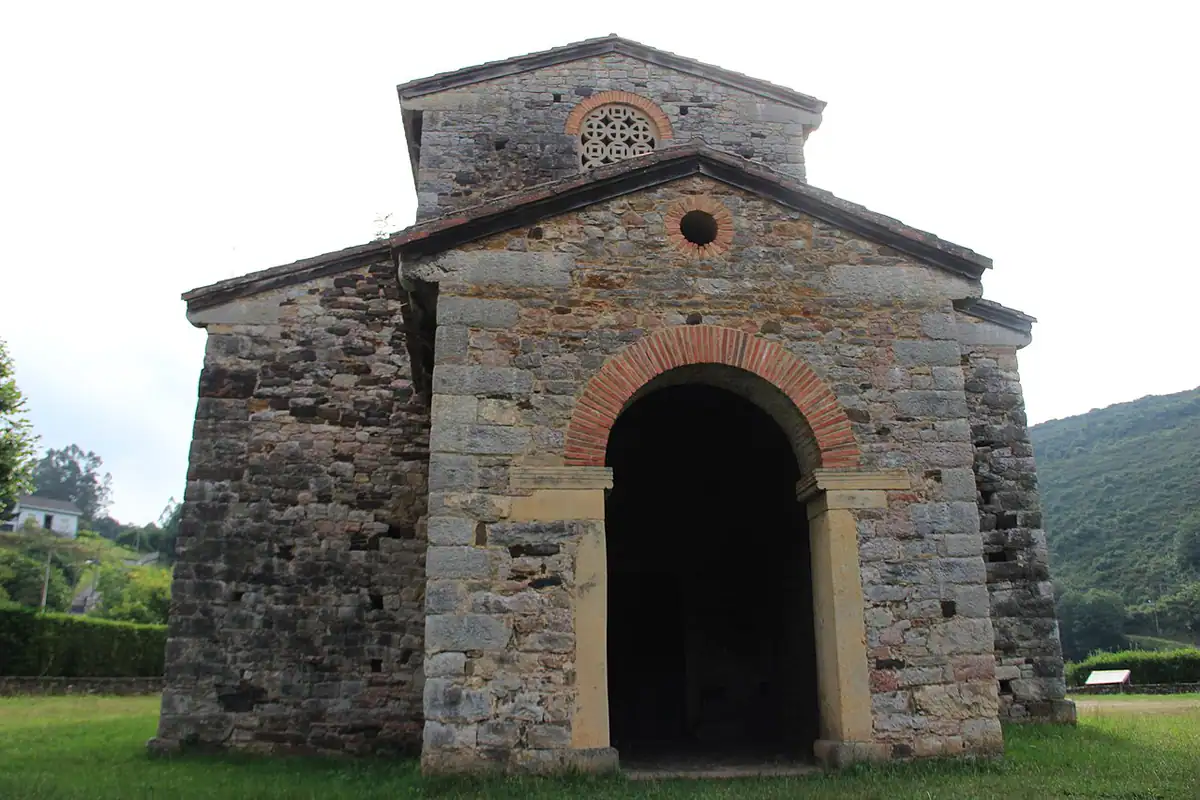
Church of San Pedro de Nora (Las Regueras)
Near the confluence of the Nora and the Nalón, a few kilometres from Oviedo, this 9th-century church is one of the most representative examples of Asturian pre-Romanesque art.
History
Turismo Asturias, the Principality’s website, places the building of San Pedro de Nora in the first half of the 9th century and notes that most studies date it to the reign of Alfonso II, like San Julián de los Prados or Santa María de Bendones. The church is a few kilometres from Oviedo, where the king had moved the court of the Kingdom of Asturias, and it is the most important pre-Romanesque monument of Las Regueras.
According to the same source, in the 9th century it was a rural aristocracy, not the king, that promoted its construction to legitimise its authority over the territory. Centuries later the clergy profited from its location, controlling the passage of goods at this crossroads and collecting duties and tithes.
Its recent history was not peaceful: in 1905 it suffered a devastating fire and years later it was partly destroyed during the Civil War. It was rebuilt by the architect Luis Menéndez Pidal, who in the 1960s raised a bell tower beside it following pre-Romanesque canons, arguing that there were foundations of an old tower there; more recent archaeological studies have not been able to confirm this. The church is on the Principality’s list of Bienes de Interés Cultural, published in 1931.
Architecture
Outside, the church is at once slender and sturdy, with alternating buttresses along its perimeter. It is entered through a vestibule and a lintelled door. The plan is basilican, with three naves: the central one, taller and wider, is separated from the aisles by square pillars carrying round arches.
The interior is trapezoidal and narrows along its 18 metres of length. The head ends in three adjoining rectangular apses, one per nave, lit by three small windows with latticework. Turismo Asturias highlights its blend of simplicity and monumentality.
The latest excavations suggest that two two-storey chapels stood beside the body of the church, perhaps rooms for ascetics in retreat or occasional lodging for nobles or kings; the original function of the site is still not fully known.
A rural aristocracy, not the king, promoted its construction in the 9th century, according to the Principality.
A crossroads
The church stands at the confluence of the rivers Nora and Nalón, an area inhabited since the Palaeolithic and crossed by the Camín Real de la Mesa, the route linking Asturias with the Castilian plateau since remote times. Turismo Asturias notes that the Camino Primitivo also runs very close by, the path that, according to the tradition it records, Alfonso II the Chaste opened as the first pilgrim.
Visiting
As of November 2026, Turismo Asturias states that only the exterior can be visited.
Getting there
San Pedro de Nora stands by the river Nora, whose meanders Las Regueras shares with the neighbouring municipality of Oviedo. The Camino Primitivo crosses Las Regueras on the Oviedo – Grado stage; see the map.
Frequently asked questions
Can you see San Pedro de Nora inside?
As of November 2026, Turismo Asturias states that only the exterior can be visited.
How old is the church?
First half of the 9th century; most studies date it to the reign of Alfonso II, according to the Principality.
Is the tower pre-Romanesque?
No: Luis Menéndez Pidal raised it in the 1960s, following pre-Romanesque canons, during the rebuilding after the Civil War.
Sources (3)
- Turismo Asturias (Principado de Asturias): Iglesia de San Pedro de Nora (accessed 20 Nov 2026)
- Turismo Asturias (Principado de Asturias): Las Regueras (accessed 20 Nov 2026)
- Principado de Asturias, Dirección General de Patrimonio Cultural: Bienes de Interés Cultural de Asturias (declarados hasta 26 de octubre de 2026) (accessed 20 Nov 2026)
- © Xuliu Pombar (CC BY-SA 4.0)