Co-cathedral of Santa María de la Redonda
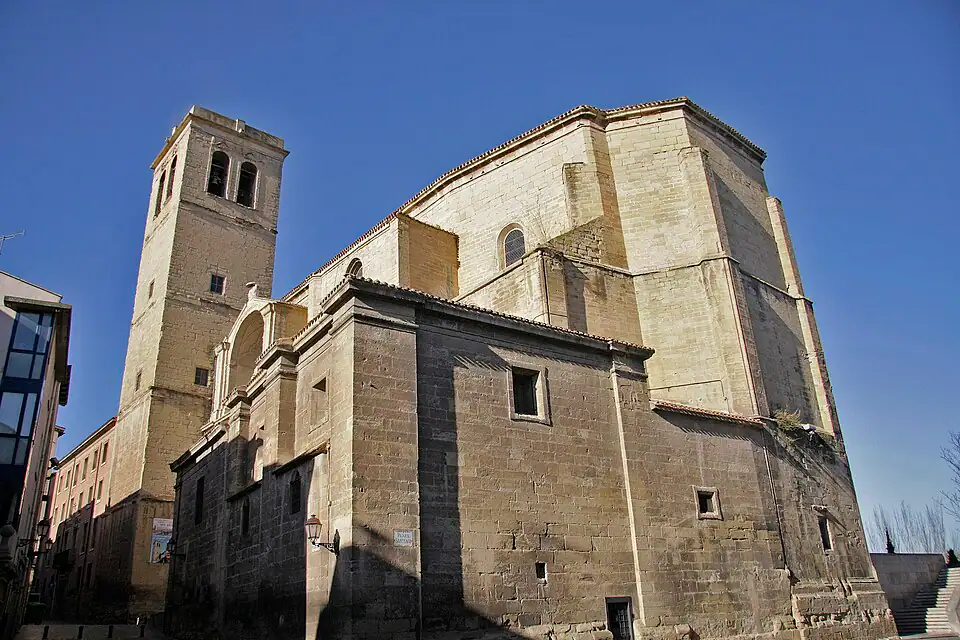
On the Plaza del Mercado, in the heart of Logroño’s old town, two twin Baroque towers announce La Redonda. It is the city’s co-cathedral, sharing with the churches of Calahorra and Santo Domingo de la Calzada the role of seat of the diocese. Its name recalls an earlier Romanesque church with a polygonal or circular plan, of which only the nickname remains.
From Romanesque church to co-cathedral
According to the City Council’s tourism portal, the first records of the church date from the late 12th century. It was then a Romanesque church with a polygonal or circular plan; of that building only the nickname “La Redonda” has survived.
In 1453 it became a collegiate church when it was united with San Martín de Albelda, which led to a major enlargement. The church was rebuilt in the 16th century, the east end was extended in the 17th and the west end in the 18th. In 1727 Pope Benedict XIII declared it “Insigne” by papal bull, the towers and chapel were completed in 1756, and in 1959 it was raised to co-cathedral.
Three naves of equal height
The interior is Gothic: three naves of the same height divided into five bays, which the Council describes as stretching lengthwise rather than across. The main door opens onto the Plaza del Mercado and the side doors onto Caballerías and Portales streets.
The west front is the Portada de los Ángeles, an example of Rioja Baroque, conceived as a great three-tier altarpiece. It is flanked by the towers, designed by Juan Bautista Arbaizar and finished by Martín Beratúa, with square lower stages, an octagonal upper stage and a pinnacled spire. The municipal portal notes that there are similar towers in Briones and Haro.
Of the round Romanesque church only the name survives: “La Redonda”, the round one.
What to see inside
The Baroque high altarpiece depicts the Tree of Jesse. The municipal portal mentions among the church’s art works by Becerra, Navarrete el Mudo or Gil de Siloé, the choir stalls carved by Arnao de Bruselas, paintings by Navarrete el Mudo such as the Penitent Magdalene, and Gregorio Fernández’s carving of the Immaculate Conception.
The church also keeps the mausoleum of General Espartero and a highly valued sculpture of the Holy Sepulchre. Its most talked-about piece is a small painting titled The Calvary, attributed to Michelangelo.
Hours and visit
According to the municipal website, it opens 8:30–13:00 and 18:00–20:45; on Sundays it closes at 14:00. Admission is free during opening hours, except during services. Guided group visits are booked on +34 941 25 76 11.
Getting there from the Camino Francés
It stands in the old town of Logroño, at the end of the Los Arcos – Logroño stage (27.6 km) of the Camino Francés. The next day the Logroño – Nájera stage (29.4 km) sets off. See the map.
What to see nearby
-
ChurchProtected heritage (BIC)
Iglesia de Santa María de Palacio


Frequently asked questions
Why is it called La Redonda?
Because the first church was a Romanesque building with a polygonal or circular plan; only the name remains.
Is it a cathedral?
It has been a co-cathedral since 1959, sharing the diocesan seat with Calahorra and Santo Domingo de la Calzada.
How much is admission?
Admission is free during opening hours, except during services, according to the municipal website.
Which Michelangelo work does it hold?
A small painting titled The Calvary, attributed to Michelangelo.
Sources (2)
- Visita Logroño (Ayuntamiento de Logroño): Concatedral de Santa María de la Redonda (accessed 19 Nov 2026)
- Visita Logroño: Logroño de iglesia en iglesia (accessed 19 Nov 2026)
- © Fernando (CC BY-SA 4.0)