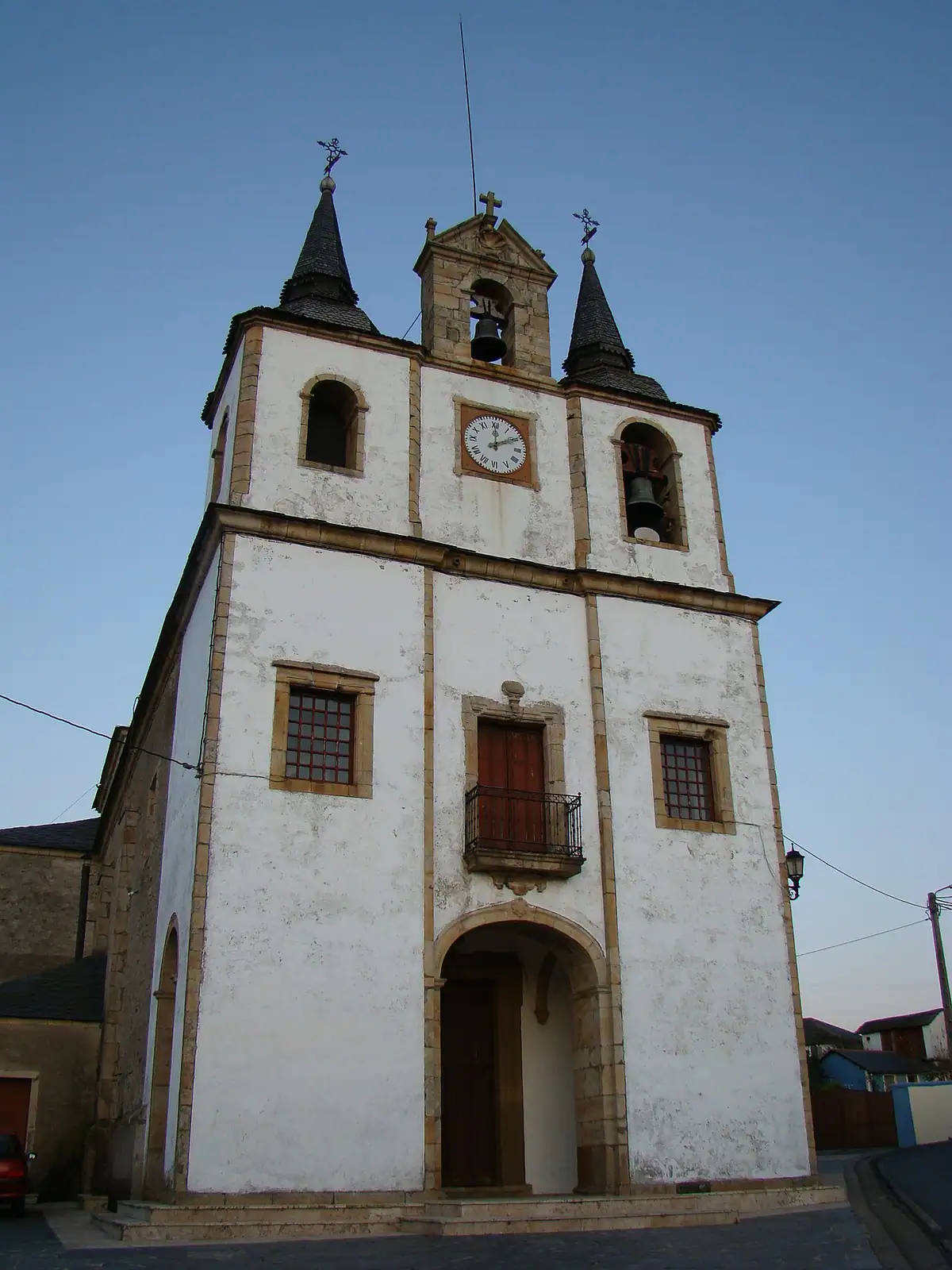
Church of Santa Marina (Puerto de Vega, Navia)
It was paid for by the people of Puerto de Vega and, above all, by their powerful guild of seafarers and merchants. The Navia town council notes that it is called, emphatically, «the cathedral of the rural Baroque of western Asturias».
History
According to the Navia town council, the church was built by José González Muñiz and José Menéndez Camina, from Avilés, between 1730 and 1749, paid for by the townspeople and especially by the powerful Gremio de Marinería y Comercio (seafarers' and merchants' guild) of Puerto de Vega. Turismo Asturias likewise places it in the first half of the 18th century. It is the church of a fishing village that, according to the council, was once a busy trading and whaling port.
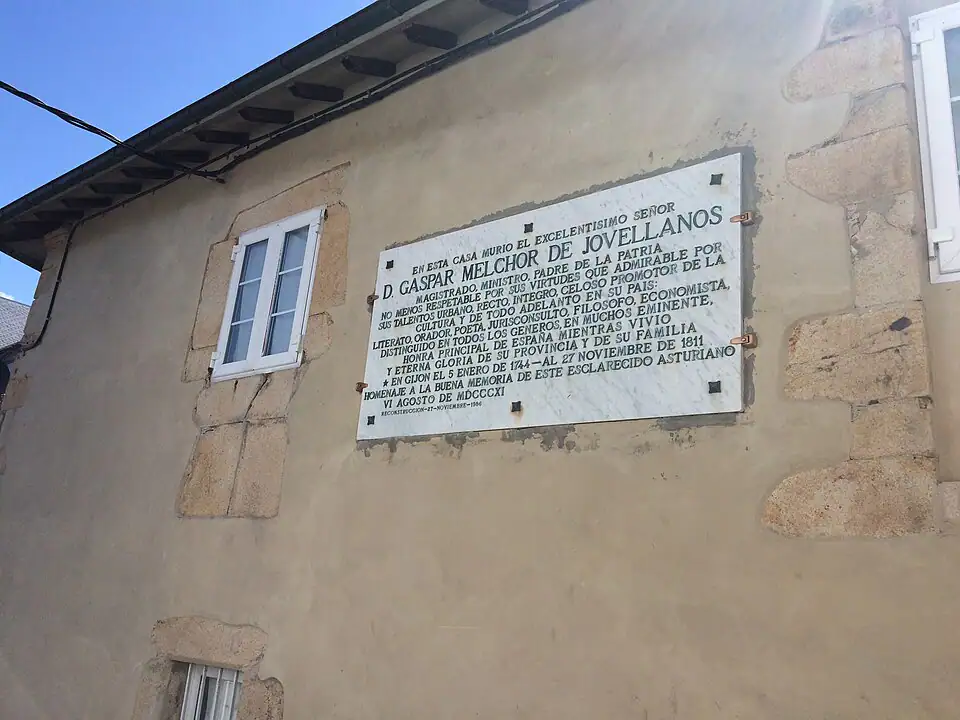
Inside, a plaque on the Epistle side recalls that the remains of Gaspar Melchor de Jovellanos lay buried here for three years. The Enlightenment statesman died in Puerto de Vega in 1811, in the Trelles house.
A three-storey façade
Turismo Asturias highlights the originality of the façade. The building is surrounded by two porches: one to the south, open and carried on columns, and another closed at the front, which rises to form the main façade. This is divided into three storeys and three bays. The ground floor opens in round arches; on the first floor there is a balcony with Baroque mouldings and ironwork between two lintelled openings; on the top floor, two round-arched openings, the taller one holding a bell, with a clock in the centre. The whole is crowned by two small towers with domes and spires and a single-opening bell gable shaped like a pediment.
The council describes the two towers topped by slate spires and, to the south, a wide porch on Tuscan columns, with a cross on the ground and remains of the endowed tombs from inside the church, from the first half of the 18th century. The whole façade is rendered rubble, with ashlar at the corners, openings, buttresses and cornice.
Emphatically, it is called «the cathedral of the rural Baroque of western Asturias», according to the Navia town council.
Altarpieces, organ and treasures
Inside there is a single, very wide nave with a rib vault, which also covers the two broad transept chapels; the crossing is topped by a dome on pendentives. For the council, the masterpiece is the Baroque altarpiece work of the sculptor José Bernardo de la Meana. The high altarpiece, of exuberant Baroque but with Rococo statuary, is presided over by the figure of the patron saint, with a medallion showing the martyrdom of the saint from Ourense. In the altarpiece of Our Lady of Mount Carmel, a central medallion shows the giving of the scapular to Saint Simon Stock. The altarpieces were restored in 1996 and 1997.
The council lists other pieces: the carved pulpit, from the old church; a 15th-century figure of Saint Blaise brought from the leper house of San Lázaro de Barayo; the chalice given by Juan Pérez Villamil, author of the Bando de Móstoles, and the monstrance of the Lebrón foundation.
The organ has its own protection. Decree 62/2017 of the Principality of Asturias declared it a Bien de Interés Cultural, as movable property, together with ten other historic organs in the region, and dates it to the 18th century. The council, by contrast, dates it to the end of the 16th century and notes that it was restored by the organ builder Gerald Grenzing.
Bien de Interés Cultural
The official list of Bienes de Interés Cultural of the Principality of Asturias includes the church of Santa Marina in Puerto de Vega, with a publication date of 7 July 2006, and, separately, its organ, published on 17 October 2017. The Navia town council describes it as «recently» declared.
Visiting
As of November 2026 we found no official opening hours. Turismo Asturias gives 985 472 220 as the church's phone number. Next to the church, the council points out the monument to the third Marquis of Santa Cruz de Marcenado, Álvaro de Navia Osorio, born in Puerto de Vega, unveiled in 1984 on the tercentenary of his birth.
From the Camino del Norte
Puerto de Vega lies on the coast of the municipality of Navia. The official sources do not place it on the route of the Camino del Norte, which according to Turismo Asturias runs through Villapedre, Piñera, home of the Camposorio manor, and the town of Navia, on the Luarca to La Caridad stage. See the map.
What to see nearby

Frequently asked questions
When was the church of Santa Marina built?
Between 1730 and 1749, according to the Navia town council; Turismo Asturias places it in the first half of the 18th century.
Who made its altarpieces?
The sculptor José Bernardo de la Meana, according to the council. They were restored in 1996 and 1997.
What is its link with Jovellanos?
A plaque recalls that his remains lay buried in the church for three years; he died in 1811 in the nearby Trelles house.
Sources (5)
- Ayuntamiento de Navia (Navia Turismo): Iglesia de Santa Marina de Puerto de Vega (accessed 20 Nov 2026)
- Ayuntamiento de Navia (Navia Turismo): patrimonio histórico (accessed 20 Nov 2026)
- Turismo Asturias: Iglesia de Santa Marina (Puerto de Vega) (accessed 20 Nov 2026)
- Principado de Asturias: Bienes de Interés Cultural declarados (PDF) (accessed 20 Nov 2026)
- BOE: Decreto 62/2017, de 20 de septiembre, por el que se declaran bien de interés cultural, con la categoría de bien mueble, once órganos históricos existentes en Asturias (accessed 20 Nov 2026)
- © Nicolás Pérez (CC BY-SA 3.0 es)