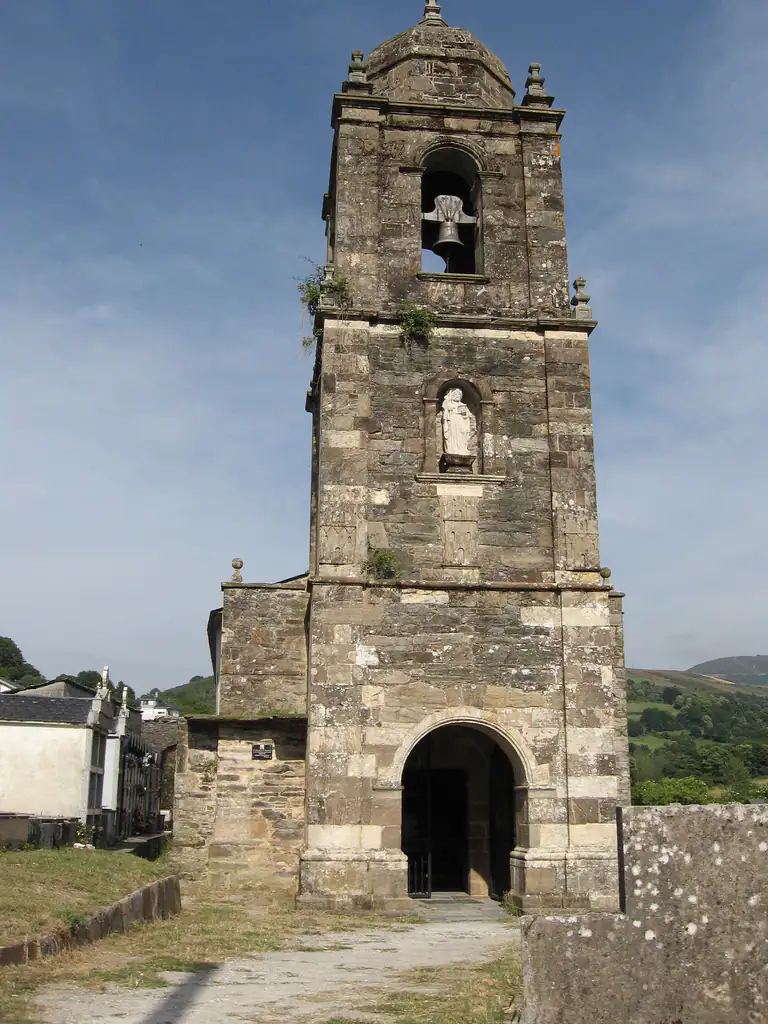
Church of Santiago in Triacastela, Romanesque with an 18th-century tower
The first thing pilgrims see as they come down into the Triacastela valley is a tall, sturdy three-stage tower. It belongs to the church of Santiago, a Romanesque church heavily remodelled in the 18th century. Its façade shows the three castles that give the village its name.
History
The church is Romanesque in origin. The Deputación de Lugo notes that researchers suggest a late date, possibly the first decades of the 13th century. It was thoroughly remodelled in the 18th century: towards the end of that century the tower was built at the west end, in works that also affected the nave walls. Turismo de Galicia dates the façade and tower to 1790.
Architecture
It has a rectangular nave with slate walls and a pitched roof, also of slate. From the Romanesque period it keeps the apse, with a straight and a semicircular section; outside, sturdy buttresses divide it into panels, and its south side was slightly altered when a modern sacristy was added.
The Deputación highlights its marked austerity: walls with few, narrow, plain openings, and uncarved corbels along the cornice of the east end.
The 1790 tower-porch
The tower has three stages. The lowest is an entrance porch with four arches; the second has a bas-relief, a niche and an inscription. The façade shows the three castles of Triacastela. There is also a sundial made from a slab of slate.
The façade and tower date from 1790; the façade shows the three castles that give Triacastela its name.
Interior
The high altarpiece is Baroque and shows the Apostle Saint James on horseback. The sacristy keeps a 12th-century silver processional cross.
Visiting
The official sources consulted give no opening times or prices: ask at the parish.
Getting there from the Camino Francés
The church is in Triacastela, end of the O Cebreiro – Triacastela stage of the Camino Francés. The Triacastela – Sarria stage starts here, via San Xil or via Samos. See the map.
What to see nearby

Frequently asked questions
Why are there three castles on the façade?
They are the three castles that give Triacastela its name, shown on the 1790 façade.
How old is the church?
It is Romanesque (the Deputación de Lugo suggests the early 13th century), heavily remodelled in the 18th century; the tower and façade date from 1790.
What is inside?
A Baroque high altarpiece with Saint James on horseback and, in the sacristy, a 12th-century silver processional cross.
Sources (2)
- Turismo de Galicia: Igrexa parroquial de Santiago de Triacastela (accessed 19 Nov 2026)
- Deputación de Lugo: Románico. Sarria, Ancares, Courel (accessed 19 Nov 2026)
- © Alejandro Moreno Calvo (CC BY 2.0)