Arnao mine and museum (Castrillón)
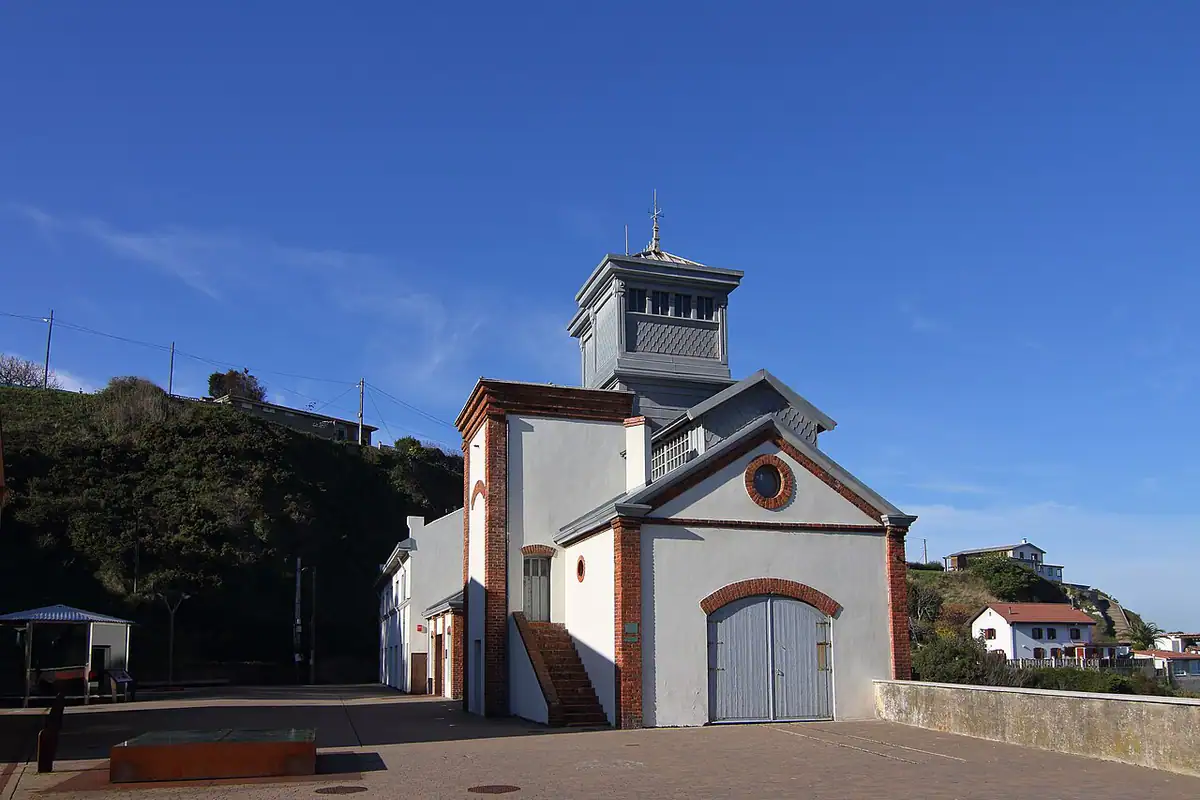
By Arnao beach, the zinc-clad wooden headframe marks the shaft of a coal mine that Turismo Asturias presents as the first undersea mine in Europe.
History
According to the dossier of the Ayuntamiento de Castrillón, in 1591 Friar Agustín Montero found a «black stone» in the Arnao cliffs and wrote to King Philip II for permission to extract it; that short-lived working is the first documented coal mine in the Iberian Peninsula.
In 1833 the founding of the Real Compañía Asturiana de Minas de Carbón by Ferrer, Riera and Lesoinne began the industrial era. Turismo Asturias lists its firsts: the first vertical shaft sunk in Asturias, the first mine in Spain to use explosives and rails and the first undersea mine in Europe, as well as the earliest records of women working at the surface of a mine. The Principality’s municipal sheet calls it «the first undersea mine in Spain» and recalls that Isabel II was the first crowned woman to visit a mine, and that Alfonso XII also went there.
The galleries were dug under the sea. In the early 20th century the water began to break in and in 1915, with new leaks and production and social problems, the mine was closed. In 2007, through a project promoted by the Ayuntamiento, the shaft was reopened and the first galleries restored.
The headframe and the village
The original headframe of 1856 is made of wood clad in zinc and keeps the cage in which the miners went down. The set includes the engine house, the landing and the transformer. It is on the Principality of Asturias list of Bienes de Interés Cultural, published in 2011.
Around the mine, and after the zinc factory was founded in 1853, a workers’ village grew up: houses, a company store, the director’s house on the hill and the old schools, whose yard keeps Father Manjón’s open-air teaching project, with relief maps of Asturias, Spain and the world laid out on the ground.
The 1856 headframe rises above the beach «like a periscope», says the Principality.
The museum
The museum occupies the original installations. The interpretation centre, in a 19th-century mining building used as a workers’ club from 1915, explains with audiovisuals, models and tools how the mine worked. The guided visit to the galleries starts at the headframe and goes down to the only visitable level, 20 metres deep, through galleries vaulted in brick and limestone.
As of November 2026, Turismo Asturias states that the museum is temporarily closed for works until further notice; the headframe and the village can be seen from outside.
Getting there
Arnao is on the coast of Castrillón, 14 km from Avilés according to Turismo Asturias, by the beach of the same name. On Xacobea, Castrillón belongs to the Avilés – Muros de Nalón stage of the Camino del Norte; see the map.
What to see nearby
Frequently asked questions
Is the Arnao Mine Museum open?
As of November 2026, Turismo Asturias states that it is temporarily closed for works until further notice.
Why is it an undersea mine?
Its galleries were dug under the seabed; sea leaks contributed to its closure in 1915.
What is protected as a Bien de Interés Cultural?
The mine headframe, on the Principality of Asturias list, published in 2011.
Sources (4)
- Turismo Asturias (Principado de Asturias): Museo de la Mina de Arnao (accessed 20 Nov 2026)
- Ayuntamiento de Castrillón: Museo de la Mina de Arnao, dossier informativo (2014) (accessed 20 Nov 2026)
- Turismo Asturias (Principado de Asturias): Castrillón (accessed 20 Nov 2026)
- Principado de Asturias, Dirección General de Patrimonio Cultural: Bienes de Interés Cultural de Asturias (declarados hasta 26 de octubre de 2026) (accessed 20 Nov 2026)
- © Malopez 21 (CC BY-SA 4.0)