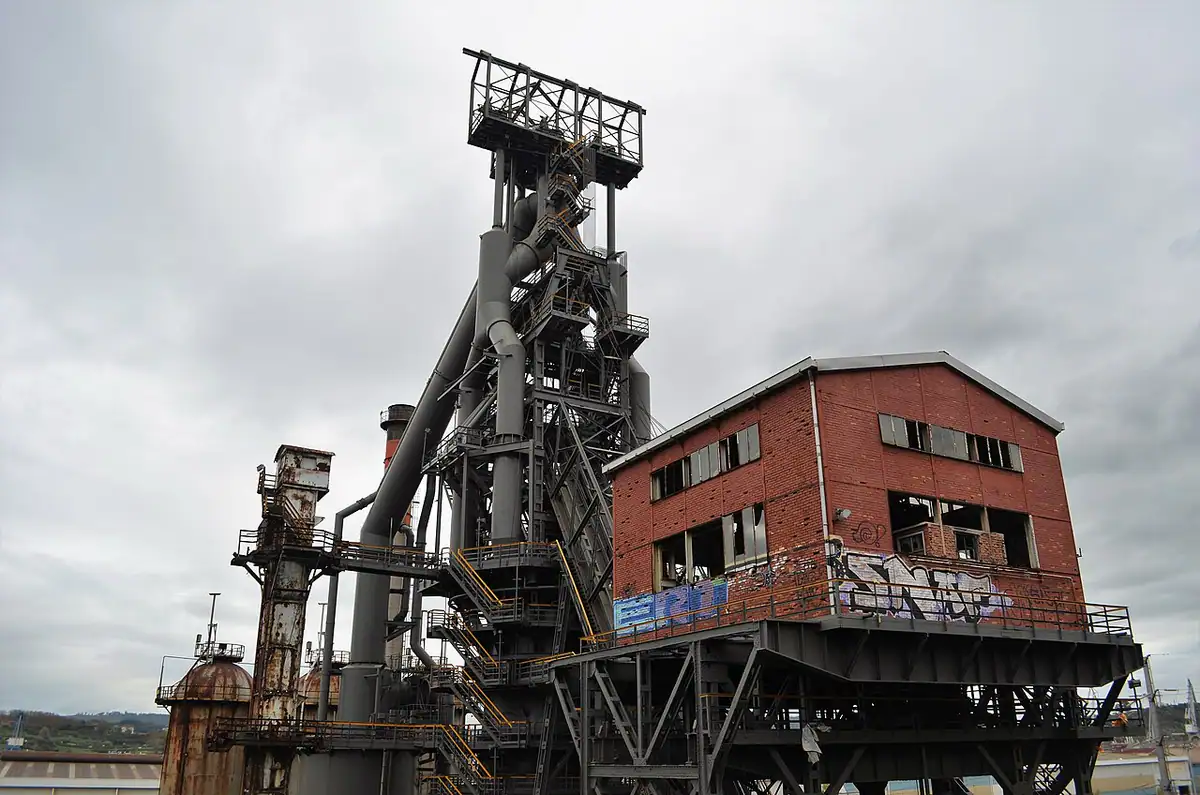
Blast Furnace no. 1 of Altos Hornos de Vizcaya (Sestao)
Of the seven blast furnaces Altos Hornos de Vizcaya once had, only one still stands: no. 1, in Sestao. Eighty metres of steel and refractory that sum up a century of iron on the Left Bank.
Altos Hornos de Vizcaya
Altos Hornos de Vizcaya was born in 1902 from the merger of two steelworks, Altos Hornos de Bilbao (formerly Nuestra Señora del Carmen) and La Vizcaya, and a tinplate factory, La Iberia. According to the Basque Government, it came to export Biscayan iron and steel to almost all of Europe, and mining, the railway network, shipbuilding and the whole auxiliary industry of the Left Bank grew around it. Its last works closed in 1996.
La Vizcaya, one of the founding companies, had appeared in Sestao between 1877 and 1885, the period of the area's greatest industrial growth, according to the Basque Government's entry on the Barakaldo slaughterhouse.
The furnace's entry opens with a text by Miguel de Unamuno in the Bilbao magazine Ecos Literarios: just as a romantic could go and meditate before an old tower house, he imagined that a romantic of the future would go and meditate before the ruins of the blast furnaces of his day. The Basque Government concludes that Blast Furnace no. 1 is indeed a symbolic image of the Industrial Revolution today.
The furnace
It is the only one of Altos Hornos de Vizcaya's seven furnaces still standing and one of the few pieces of industrial heritage left from the company. It opened in November 1959 and was the twin of Blast Furnace no. 2 beside it. At first it doubled the output of the earlier furnaces, with 600 tonnes a day; after several refits, at the end of its working life in 1995, it produced 1,500 tonnes a day.
It is 80 metres tall in total and rests on a ring girder. The hearth is 6 metres in diameter, the interior 25 metres high with 720 m³ of useful volume. Inside it is lined with refractory material and the outer shell is welded plate.
The only one of Altos Hornos de Vizcaya's seven furnaces still standing.
How it worked
Iron ore, coke and lime as flux were charged from the top. As it was recharged from above, pre-heated air was blown in through 14 tuyères at the base. When the charge melted the gases were drawn off, and liquid pig iron collected at the bottom of the hearth with slag floating on top; both were tapped off through channels.
It needed a crew of nine: a tapping master, an assistant, two helpers, a slag man, a cooling watchman, an engine driver, a foreman and a shift manager.
Visiting
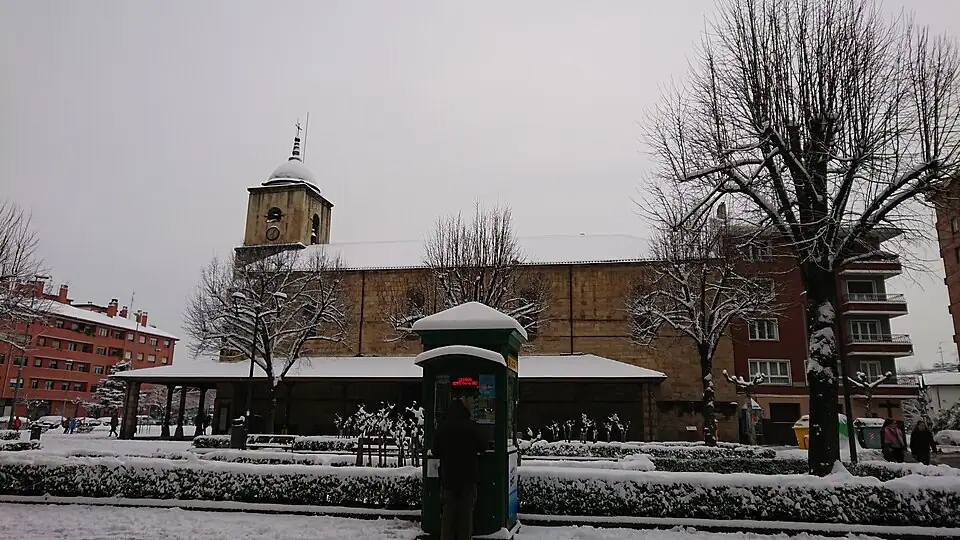
As of November 2026 we have not found official hours for visits inside. The furnace can be seen from outside. Sestao also keeps the workers' house La Galana and, on top of the hill, the church of Santa María.
On the Camino del Norte
The Basque Government includes the furnace in its heritage inventory of the Camino del Norte on the stage from Bilbao to Portugalete. The stage guide brings the Camino into Sestao at km 17.8, after crossing the river Galindo, and takes it through the Simón Drogas area and along Gran Vía J. A. Aguirre y Lekube to the town hall, and from there to Portugalete. See the furnace on the map.
What to see nearby


Frequently asked questions
How many furnaces did Altos Hornos de Vizcaya have?
Seven, according to the Basque Government. No. 1 in Sestao is the only one still standing.
When did it stop working?
It worked from November 1959 to the end of its working life in 1995; the company closed its last works in 1996.
How tall is it?
80 metres in total, with a hearth 6 metres in diameter.
Sources (3)
- Gobierno Vasco, Patrimonio Cultural: Camino de la Costa, Horno 1 de AHV (Sestao) (accessed 20 Nov 2026)
- Gobierno Vasco, Patrimonio Cultural: Camino de la Costa, Matadero municipal de Barakaldo (accessed 20 Nov 2026)
- Gobierno Vasco: Camino de Santiago, tramo Bilbao–Portugalete (PDF) (accessed 20 Nov 2026)
- © Yandrak (CC BY-SA 4.0)